The case for Dubai is no longer about tax. It’s about being in the city where 66% of MENA capital, the top 1% of founders, and the regulatory frameworks of the next decade now converge. Here’s what that actually means for your business.
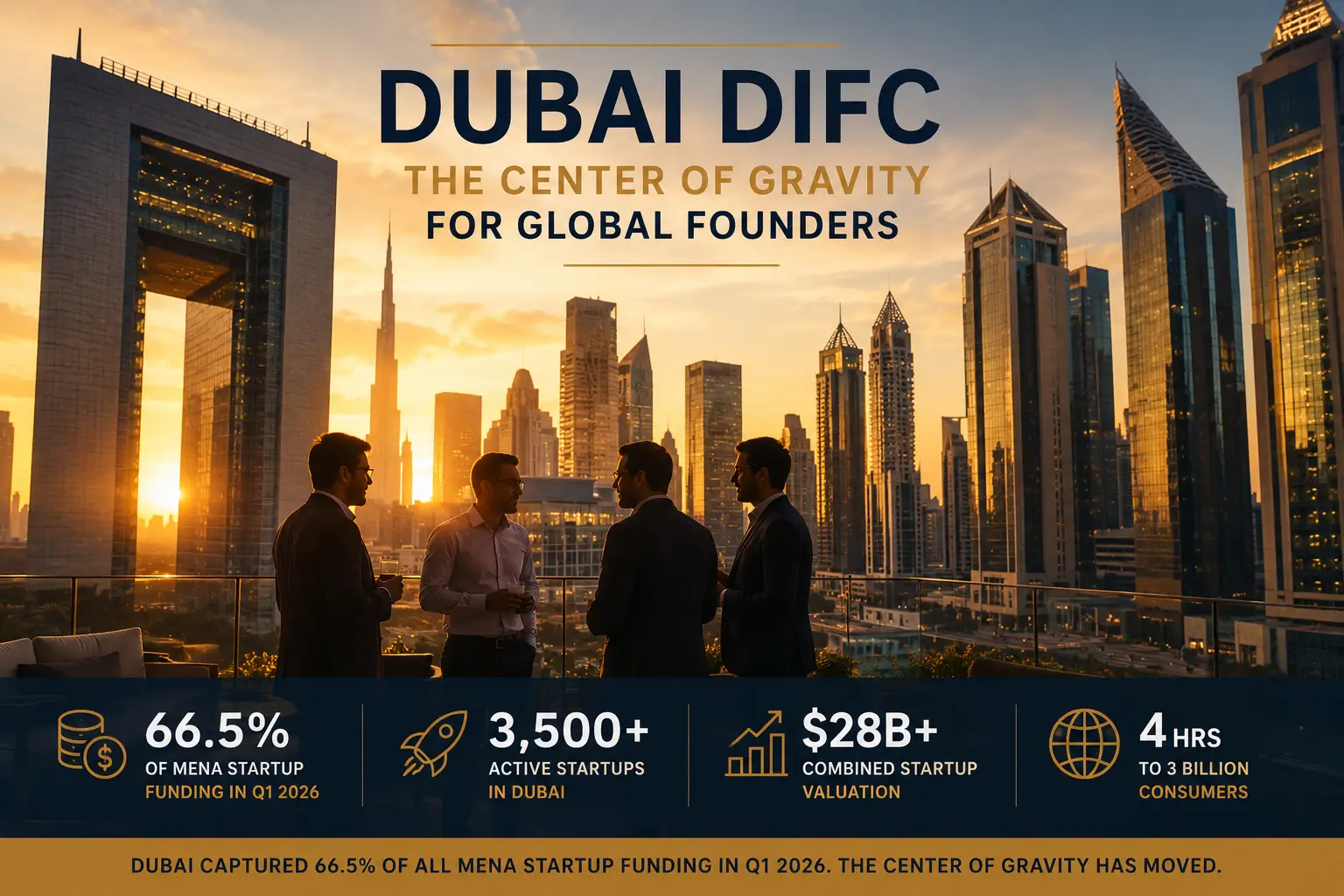
 Dubai captured 66.5% of all MENA startup funding in Q1 2026. The center of gravity has moved.
Three years ago, “founders moving to Dubai” was a lifestyle headline. Today it’s a capital-flow story.
In Q1 2026, UAE-headquartered startups raised $625.8 million across 46 deals. That’s 66.5% of all venture capital deployed across the MENA region in a single quarter, and the highest concentration the country has ever recorded. The previous year, UAE startups raised $2 billion across 218 deals. Dubai alone now hosts more than 3,500 active startups with a combined valuation north of $28 billion.
This isn’t a trend. It’s a structural shift. And the founders who recognized it early are already operating from inside one of the world’s three most pro-entrepreneur jurisdictions, with the tax position, residency stability, and capital access to match.
If you’re a founder doing seven figures or scaling toward it, and you’ve been thinking seriously about Dubai but haven’t pulled the trigger, this page is for you.
| Is Dubai actually right for YOUR business?
Before you commit AED 250,000+ on relocation, find out exactly where your business is being limited right now. The 2-minute Bottleneck Quiz tells you whether moving to Dubai solves your real problem, or whether the bottleneck is somewhere else entirely. Most founders are surprised by the answer. |
Why founders are quietly relocating to Dubai in 2026
Four shifts have made Dubai the highest-conviction founder bet of the decade. Not influencer hype. Verified, structural changes:
| 66.5%
Share of MENA startup capital deployed in the UAE during Q1 2026 |
1. Capital is consolidating here
UAE startups raised $625.8 million in Q1 2026, accounting for two-thirds of all MENA venture capital, per Wamda and Business Today Middle East. The closest competitor (Saudi Arabia) raised $156.7M. Egypt raised $86M. The gap is no longer narrowing. It’s widening.
What this means for founders: if you’re raising capital that touches MENA in any capacity, your investor density per square kilometer is higher in Dubai than anywhere else in the region. The conversations you have to schedule weeks in advance elsewhere happen by accident over coffee here.
2. The regulatory framework now favors founders explicitly
Three structural changes in the past 36 months:
- 100% foreign ownership on mainland businesses (since 2021) in over 1,000 commercial and industrial activities. No more local partner requirement.
- Golden Visa program expanded multiple times in 2025-2026. Founders generating AED 1M+ in annual revenue now qualify for 10-year residency. AI specialists get 7-day expedited processing.
- D33 Economic Agenda allocated $27 billion to innovation, digital business, and future industries. The government actively positions itself as a founder ecosystem.
Dubai now ranks #3 globally on the Startup Friendly Cities Index 2026, outperforming Tokyo and Los Angeles on the combined measure of safety, healthcare, and purchasing power.
3. The tax position is still real (with conditions)
Personal income tax: still 0%. Salaries, dividends, capital gains for individuals are not taxed.
Corporate tax: 9% on profit above AED 375,000 since June 2023. Free zone companies that meet the Qualifying Free Zone Person (QFZP) conditions can still operate at 0% on qualifying income.
The mathematics on this saves a UK founder taking £325,000 annually roughly £140,000 to £170,000 per year compared to London, depending on structure. Compound that over a decade and it’s the cost of a substantial asset.
For the full breakdown of the 2026 tax landscape, including the five QFZP conditions and the 5-year lockout penalty for non-compliance, see our Free Zone vs Mainland guide.
4. Geographic positioning becomes more valuable as the world fragments
Dubai sits within a 4-hour flight of 3 billion consumers. Eight hours from London. Fourteen from New York. Seven from Singapore. As geopolitics fragments and capital flows reorganize around fewer hub jurisdictions, this position becomes more valuable, not less.
The founders relocating in 2026 aren’t doing it for the weather. They’re doing it because Dubai sits at the intersection of MENA capital, Asian growth markets, and European compliance frameworks. No other city offers that combination in a 0% personal tax environment.
Who Dubai actually fits (and who it doesn’t)
This is the section most relocation content skips. The honest framing:
Dubai is the right move for you if:
- You’re past your first $1M ARR. Below that, the relocation cost (AED 237K to 536K in year one) exceeds the tax savings. Stay where you are. Reassess at $2M+.
- Your business serves global or regional customers. Cross-border consulting, SaaS, holding structures, international trade, content businesses with global audiences, fund management. The 0% QFZP qualifying-income structure rewards this model.
- You can maintain real operational substance. Adequate office, qualified employees, decisions made locally. The QFZP framework requires this and the FTA is actively auditing shells.
- You’re scaling and need denser network. Dubai concentrates more 7-figure founders per square kilometer than any city outside Singapore. The network effect compounds fast.
- Your investors, partners, or operational team are MENA-adjacent. Family offices, sovereign wealth, Indian/African market access, fintech regulators, crypto frameworks all converge here.
Dubai is NOT the right move for you if:
- Your business is purely US-customer-facing under $2M ARR. US tax obligations don’t disappear when you move. The relocation math only works above a certain scale.
- You can’t tolerate the summer climate (40-48°C from June to September) or have specific health considerations.
- You’re chasing the Instagram lifestyle. Dubai filters these out within 12 months. Real founders here are heads-down operators, not influencers.
- You haven’t researched the cultural and legal context. UAE is liberal regionally but more conservative than most Western capitals. Business contracts, public conduct expectations, and personal conduct differ. Read before you commit.
If you’re in the first list, the rest of this page is for you. If you’re in the second list, the most useful next step is honest reflection, not relocation.
| Still uncertain which list you fit?
The 2-minute Founder Bottleneck Quiz is built specifically for founders evaluating major operational decisions like this one. It tells you what’s actually limiting your business and whether relocation moves that needle. |
What’s changed since 2024 (the updates most articles miss)
The Dubai of 2024 is not the Dubai of 2026. Five material changes have happened:
Corporate tax is now operational, not theoretical
Introduced in June 2023, the 9% corporate tax on profit above AED 375,000 is now in full force. The FTA is actively reviewing first-wave returns and auditing free zone companies for QFZP compliance. The era of “set up a shell, pay zero tax” is over.
From April 14, 2026, the late payment penalty was restructured to 14% per annum under Cabinet Decision No. 129 of 2025. From 2025 onwards, all QFZPs must file audited IFRS financials. The compliance overhead is real.
Golden Visa eligibility expanded significantly
In February 2026, the 50% upfront payment requirement for mortgaged property was removed. Real estate investors now qualify based solely on AED 2 million total property value, regardless of mortgage balance.
New categories added in 2025-2026: educators, content creators, AI specialists (7-day expedited track), yacht owners, humanitarian workers. The program is becoming materially easier to qualify for.
Mainland ownership permanently liberalized
The 2021 amendment to the Commercial Companies Law allowing 100% foreign ownership of mainland businesses has now been fully implemented across more than 1,000 commercial and industrial activities. The historical reason most foreigners chose free zones (avoiding the 51% local partner requirement) no longer applies.
Banking has tightened but stabilized
UAE banks de-risked aggressively post-2023. Crypto-exposed businesses, businesses with unclear shareholder structures, and digital-first models face longer KYC processes (8 to 12 weeks at tier-one banks). But the rules are now clearer and the path is predictable for founders with proper documentation.
Crypto and Web3 got a real regulatory framework
VARA (Virtual Assets Regulatory Authority) became the world’s first dedicated crypto regulator. DIFC’s DFSA and ADGM’s FSRA provide complementary frameworks. Founders operating in Web3 globally now have a real reason to consider Dubai jurisdiction: regulatory clarity that doesn’t exist in the US or most of Europe.
The Four Pillars of Dubai for Founders (PlanX’s framework)
At PlanX we think about Dubai relocation through four interconnected pillars. Founders who win here address all four. Founders who skip one pay for it within 18 months.
Citizenship: residency that compounds
Most founders default to the 2-year Investor Visa because it ships automatically with company setup. The smarter play is to qualify for the 10-year Golden Visa from day one. It’s self-sponsored, covers family, and lets you stay outside the UAE indefinitely without losing status.
Beyond UAE residency, the strategic move is layering: UAE Golden Visa for operational base, second citizenship for passport diversification, structured residency in 2 to 3 jurisdictions for asset and risk diversification. This is what the top 1% of founders quietly do.
Full breakdown: the Dubai Golden Visa Playbook.
Compliance: structure that survives audits
The QFZP framework rewards real operational substance and punishes shells. The 5-year lockout penalty for failing any of the five conditions (substance, qualifying income, de minimis test, no mainland election, audited transfer pricing) means structuring decisions made today shape your tax position through 2031.
Founders who get this right: spend AED 5,000 to AED 15,000 on a UAE-licensed tax consultant BEFORE incorporating. Get the structure right once. The downstream cost of restructuring is 10x to 50x the upfront consulting fee.
Capital: banking and wealth access at scale
UAE banking has consolidated around 6 to 8 tier-one institutions (Emirates NBD, ADCB, FAB, HSBC UAE, Mashreq, ENBD Private Banking, plus DIFC-licensed private banks). Account opening is methodical: 3 to 8 weeks for most businesses, longer for crypto or complex structures.
Beyond banking, Dubai now hosts one of the highest concentrations of family offices outside London and Geneva. The DIFC Innovation Hub events, DAIS (Dubai Alternative Investment Summit), and curated family office gatherings are where institutional wealth conversations actually happen.
Commerce: operating globally from a single base
Dubai’s positioning is best used as a hub, not a destination. The founders who win operate FROM Dubai across multiple markets: Europe via short-haul flights, Asia via direct routes, Africa via expanded ADIA-backed infrastructure, the Americas via stable connectivity.
This is where the geographic dividend compounds: low tax + global reach + regulatory clarity + 0% personal income tax + strong currency peg (AED to USD at 3.67). No other major founder hub offers this stack.
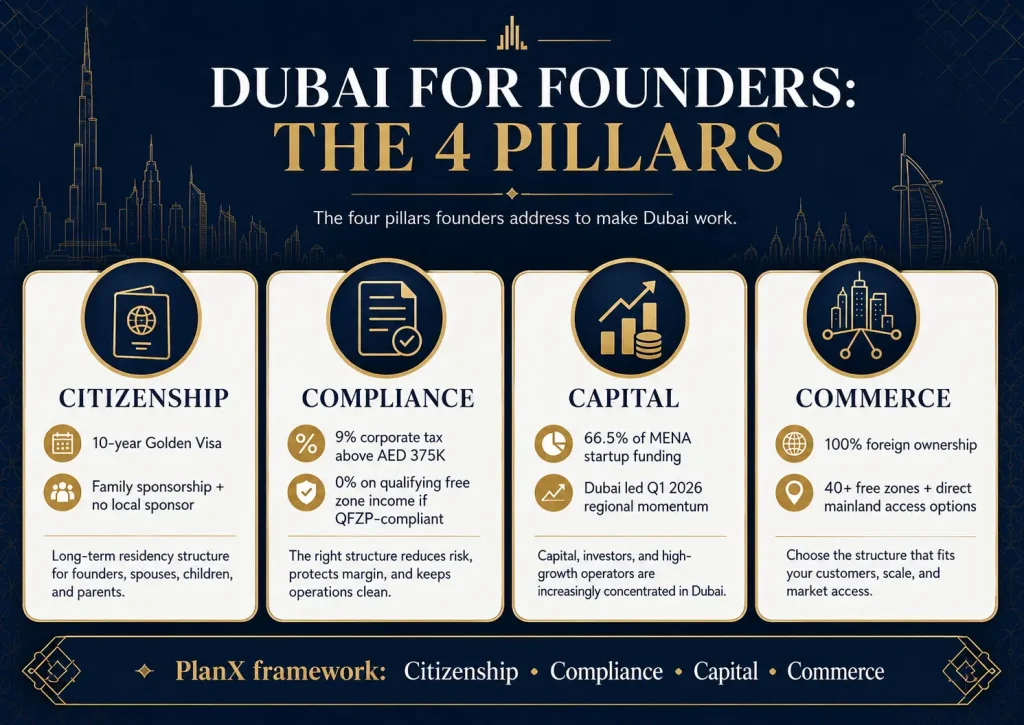 The four pillars founders address to make Dubai work.
What relocation actually looks like (90-day reality)
Most founders underestimate the timeline. Realistic sequence:
Days 1-30: decisions and incorporation
- Visit Dubai for 3-5 days. Walk neighborhoods. Meet 2-3 setup consultants and a tax advisor.
- Decide free zone or mainland (see our guide for the framework).
- Submit license application. Free zone: 1-14 days. Mainland: 2-3 weeks.
- Submit visa application. Entry permit issued.
Days 31-60: arrival and setup
- Arrive in UAE. Medical fitness test. Biometrics. Emirates ID issued (2-4 weeks).
- Begin business bank account application (3-8 weeks total at tier-one banks).
- Use short-term housing while you find permanent.
Days 61-90: operations and family
- Sign 12-month housing lease, set up Ejari.
- Bank account approved. Begin moving operations.
- Apply for family visas if applicable.
- Family arrives. Schools start (apply 12 months in advance for top schools).
- Begin embedding in the founder network.
| All-in first-year cost
Solo founder: AED 237,500 to AED 536,250 (USD 65,000 to USD 146,000). Family of four with international schools: add AED 250,000 to AED 400,000 per year. The math works for founders past $1M ARR with international clients. It doesn’t for founders below that scale. |
For the complete 90-day playbook with realistic timelines, full cost breakdown, and the trade-offs nobody mentions on Instagram, see our pillar guide on moving to Dubai.
The complete Dubai founder roadmap
This page is the strategic case. The execution lives in our cluster content. Bookmark these and work through them in order:
- Step 1: Move to Dubai (Pillar Guide) , the complete 90-day relocation playbook with visa options, setup costs, tax reality, housing, and trade-offs.
- Step 2: Dubai Golden Visa Playbook , which of the 5 categories fits your situation, exact 2026 costs, application steps, and the 13 reasons applications get rejected.
- Step 3: Dubai Free Zone vs Mainland , the structuring decision that determines your tax position for the next 5 years. Free zone vs mainland by 8 factors.
- Step 4: 12 Dubai Networking Events Worth Your Time , ranked guide to where founders actually do deals, not where they collect business cards.
Where the Dubai founder ecosystem meets in person: PlanX 2026
Reading is one input. Meeting the operators face-to-face is what compresses the timeline from years to months.
PlanX 2026 is the 2-day founder conference in Dubai where the tax structurers, immigration advisors, family offices, banking specialists, and 7-figure founders all converge. November 25 to 26 at Grand Hyatt Dubai. 2,500 founders. 40+ speakers. Three tracks: Growth, Leverage, Network.
If you’re seriously considering Dubai, attending PlanX 2026 is the single highest-leverage step you can take. Two days face-to-face with the people who can answer your specific questions, validate or invalidate your structuring assumptions, and connect you to the operators who’ve done what you’re about to do. The same conversations that take 12 months to schedule individually happen in 48 hours.
| Lock in your PlanX 2026 ticket
Super Early Bird Global Access at $299 (50% off, available May-June). Or upgrade to the Limited Offer at $698 (includes 2 nights at the 5-star Grand Hyatt, only 150 units total). Or go Sovereign VIP for the private yacht after-party at $599 Super Early Bird. |
FAQ: Dubai for Entrepreneurs in 2026
Is Dubai actually good for entrepreneurs in 2026 or is it overhyped?
Dubai is genuinely good for founders past their first $1M ARR with international or regional customers. The fundamentals are real: 0% personal income tax, 100% foreign ownership, 10-year Golden Visa availability, world-class infrastructure, and the highest concentration of MENA venture capital. It’s overhyped for founders below $1M who serve only their home market. The relocation cost won’t pay back at that scale.
What’s the minimum revenue I should have before moving my business to Dubai?
Realistic floor is $1M ARR with at least 30% of revenue coming from international or regional customers. Below that, first-year relocation cost (AED 237K to 536K solo, more for families) exceeds the tax savings. At $2M+ ARR with global customers, the math typically works in year one.
What’s the easiest way to move to Dubai as an entrepreneur?
Set up a free zone company (typical zones: DMCC, IFZA, Meydan, or DIFC depending on your business). The company setup automatically generates an Investor Visa. From there, upgrade to a Golden Visa once you qualify (AED 1M+ annual revenue or AED 2M+ investment). Total setup: 30 to 60 days for solo founders, 90 days for families.
What’s the difference between a free zone and mainland company?
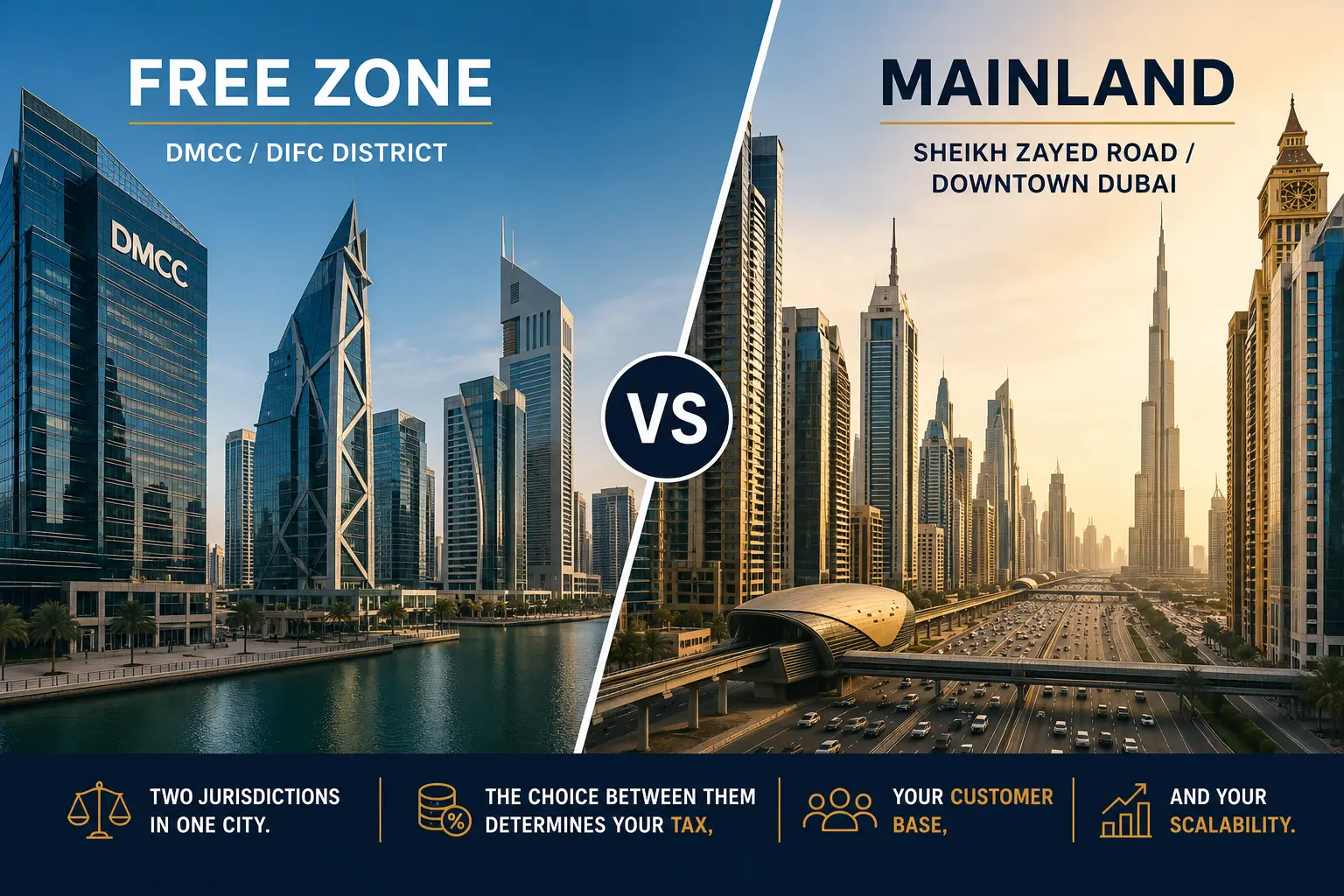
Free zone: cheaper setup, faster, 100% foreign ownership, 0% corporate tax on qualifying income (if QFZP conditions met), but cannot directly trade with UAE mainland customers. Mainland: higher setup cost, slower, 100% foreign ownership in most sectors since 2021, can trade anywhere in the UAE, 9% corporate tax above AED 375K. Decision depends primarily on where your customers are.
Do entrepreneurs really pay 0% tax in Dubai in 2026?
Personal income tax: yes, 0% on salaries, dividends, and capital gains. Corporate tax: 9% on profit above AED 375,000 since June 2023. Free zone companies meeting QFZP conditions can still operate at 0% on qualifying income. The era of “zero tax everywhere” ended in 2023. Today’s tax position requires proper structuring to optimize.
Can I keep my US business while moving to Dubai?
Yes. Many founders maintain operations in their home country while relocating personally to Dubai for residency, tax, and lifestyle reasons. US citizens always pay US federal tax regardless of residence, so structure carefully. UK, EU, and most other jurisdictions allow you to break tax residency once you’ve established UAE residency and physical presence (typically 183 days/year or 90 days with primary economic interests in UAE).
How long does it take to fully relocate to Dubai as an entrepreneur?
60 to 90 days for solo founders who are prepared. 90 to 180 days for families with school placement. Anyone promising 30 days for a full family relocation with operating business is selling something. School waiting lists alone (12 to 24 months at top-tier British/American schools) often dictate the timeline more than visa processing does.
Is Dubai safe for foreign entrepreneurs and their families?
Yes. Dubai consistently ranks among the world’s safest major cities. The Startup Friendly Cities Index 2026 ranked Dubai #3 globally on the combined measure of safety, healthcare, and purchasing power, ahead of Tokyo and Los Angeles. The regulatory environment is predictable, contracts are enforceable, and personal safety for residents is strong.
What kind of entrepreneurs is Dubai best suited for?
Cross-border service businesses (consulting, SaaS, content), holding structures and family offices, fintech and crypto founders (now with regulatory clarity via VARA, DFSA, FSRA), commodities and trading, e-commerce with global audiences, and founders raising capital from MENA family offices. Less suited: purely local-market businesses, certain regulated industries (US-specific compliance), and lifestyle-driven moves without business rationale.
How is Dubai different from Singapore for entrepreneurs?
Both are pro-business jurisdictions with strong infrastructure. Dubai wins on: 0% personal tax (Singapore tops out at 24%), faster company setup, lower entry investment, easier residency (10-year Golden Visa vs Singapore’s more restrictive paths), warmer climate (subjective). Singapore wins on: more mature financial regulation, English common law (vs UAE civil law), proximity to Southeast Asian growth markets, and a longer track record of corporate stability.
What about Dubai versus other zero-tax jurisdictions like the Cayman Islands or Bermuda?
Cayman and Bermuda are tax havens with limited operational infrastructure. Dubai is a fully operating economy with 3.6 million residents, world-class universities, advanced healthcare, deep capital markets, and direct flights to most major business cities. You can actually run a business from Dubai with employees, customers, and partners physically present. You cannot do that in the same way from Cayman or Bermuda.
Should I attend PlanX 2026 before deciding to move to Dubai?
If you’re seriously considering relocation, yes. PlanX 2026 compresses 6 to 12 months of advisor conversations, network introductions, and operational research into 48 hours. You meet the tax structurers, immigration advisors, banking specialists, and 7-figure founders who’ve already done what you’re considering. The Super Early Bird ticket ($299 Global Access) costs roughly the same as a single 1-hour consultation with a top advisor, and you get 2 days of access to dozens of them.
The next step depends on where you actually are
Three scenarios. Three different next moves:
If you’re still figuring out whether Dubai is right for you:
Take the 2-minute Bottleneck Quiz. It tells you what’s actually limiting your business right now and whether relocation moves that needle, or whether the real bottleneck is somewhere else entirely. Most founders are surprised by what they learn.
| Find your bottleneck first
The 2-minute assessment built for founders past their first $1M. Honest analysis of what’s actually capping your growth right now. Free. |
If you’ve decided Dubai is the move:
Read the pillar guide. Understand the 90-day timeline. Then commit to attending PlanX 2026 in November to compress your advisor and network conversations from months into days.
| Lock in PlanX 2026 before pricing increases
Super Early Bird Global Access: $299 (May-June only, increases to $499 in July). Limited Offer with 2 nights at Grand Hyatt: $698 (only 150 units total). Sovereign VIP with private yacht after-party: $599 Super Early Bird. |
If you’re already operating from Dubai and want to plug deeper into the ecosystem:
Same answer. PlanX 2026 is engineered specifically for the founder-density problem that wastes 6 to 12 months of new arrivals’ time. Two days, the right rooms, real conversations.
This is the city of the next decade for founders willing to do the work. The math has changed. The infrastructure has changed. The regulatory framework has changed. The network is here.
What you do with that is up to you.