The complete 2026 guide to the Dubai Golden Visa. Eligibility tiers, exact costs, application process, recent rule changes, and the mistakes that cause most rejections.
The 10-year Golden Visa: residency, family sponsorship, and no requirement for a local sponsor.
If you’ve made it past the basics of moving to Dubai, the Golden Visa is what you actually want. Not the 2-year investor visa that ties you to one company. Not the 5-year Green Visa that gets you halfway there. The 10-year, renewable, self-sponsored Golden Visa with full family coverage and the ability to stay outside the UAE indefinitely.
In 2026, qualifying for it is easier than it’s ever been. The UAE expanded eligibility three times in the past 18 months. They added educators, content creators, AI specialists, yacht owners, and humanitarian workers. They removed the 50% upfront payment requirement on mortgaged property in February. The process can now move in 15 to 30 days for prepared applicants. AI specialists can get a 7-day expedited track.
But the rejection rate has also climbed. The UAE rejects 5 to 6 out of every 100 applications daily, often for issues that have nothing to do with eligibility and everything to do with how the application was prepared.
This is the playbook. The five categories that matter for founders and investors, exact 2026 costs, the realistic step-by-step process, and the 13 specific mistakes that get applications rejected. We’ve worked through this with hundreds of founders in our community through Road to PlanX events, spoken with the immigration consultants who handle these daily, and watched both the wins and the avoidable rejections.
If you’re still deciding whether to move to Dubai at all, start with our pillar guide first.
If you’ve already decided and you’re trying to figure out which Golden Visa category fits your situation, you’re in the right place. Our complete founder’s guide to moving to Dubai covers the broader context.
| Not sure if relocation is your real bottleneck?
Take the 2-minute Founder Bottleneck assessment before you spend AED 10,000 on a visa. It shows you exactly where your business is being limited right now. Sometimes the answer isn’t relocation. It’s something fixable from your desk. |
What the Dubai Golden Visa actually is
The Golden Visa is a long-term residency permit issued by the UAE government. Validity is 5 or 10 years depending on category. It’s renewable automatically. The official platform of the UAE Government administers it through two main authorities: the Federal Authority for Identity, Citizenship, Customs and Port Security (ICP) for most of the UAE, and the General Directorate of Residency and Foreigners Affairs (GDRFA) for Dubai-specific applications.
It was launched in 2019 as part of UAE Vision 2030. The goal was to attract investors, entrepreneurs, and high-skill talent. Since then, the eligibility categories have expanded steadily. As of 2026, the program covers investors, entrepreneurs, specialized talents, scientists, doctors, executives, artists, athletes, humanitarian pioneers, top students, and several newer categories.
What you get with it
- 10-year renewable residency (5 years for some categories)
- No local sponsor or employer required
- Full family sponsorship: spouse, children, and parents on a single application
- Stay outside the UAE indefinitely without losing residency (no 180-day rule)
- 100% business ownership across the UAE
- Sponsor domestic helpers without limits
- 24/7 consular and emergency support abroad (new 2025-2026)
- Esaad privilege card: discounts at 7,000+ UAE businesses and 92 countries globally
- Tax-free personal income, dividends, and capital gains
What you don’t get
- Voting rights or political participation
- A path to UAE citizenship (this is residency, not naturalization)
- Guaranteed approval (the visa requires meeting category-specific criteria)
- Permanent status (renewals are automatic but conditional on continuing eligibility)
The 5 categories that matter for founders and investors
There are more than a dozen total Golden Visa categories. For founders, investors, and business owners, five of them cover almost every realistic path. Pick the strongest one. You can only apply under one category at a time, and the wrong choice means starting over.
Category 1: Public Investor (AED 2 million)
The most common founder path. Three sub-routes, all requiring AED 2 million minimum, all requiring the capital be wholly owned (not loaned).
Path 1a: Deposit AED 2 million or more in a UAE bank. The deposit must be held with an accredited local UAE bank and frozen for a minimum of two years. Investment funds and local sukuk also qualify.
Path 1b: Establish or partner in a UAE company with AED 2 million in capital. You’ll need a valid commercial or industrial license, the company’s Memorandum of Association showing your share, and a partners’ annex if applicable.
Path 1c: Pay AED 250,000 or more in annual federal taxes. You’ll need a confirmation letter from the Federal Tax Authority stating your annual tax contribution.
Best for: Founders with significant liquid capital who want flexibility. The deposit route is the cleanest if you have the cash. The capital route makes sense if your business is already operating with AED 2 million+ in paid-up capital.
Category 2: Real Estate Investor (AED 2 million)
Own property in the UAE valued at AED 2 million or more, certified by the Dubai Land Department. This is the route most international investors take.
| February 2026 update: Mortgaged property rules relaxed
Until February 2026, mortgaged property only qualified if the investor had paid at least 50% of the value (or AED 1 million minimum). That requirement has been removed. Now eligibility is determined solely by total property value reaching AED 2 million, regardless of outstanding mortgage balance. This applies to ready, off-plan, and mortgaged properties. UAE bank financing is fully accepted. |
Multiple properties are allowed. If you own a portfolio worth AED 2 million total, you qualify. If ownership is joint, your individual share must be at least AED 2 million.
Important: the property valuation that matters is the Dubai Land Department figure, not the contract price. Get a valuation certificate from a DLD-licensed office before you assume you qualify.
Best for: Investors who want their AED 2 million to do double duty. Property appreciates, generates rental income, and grants residency. The mortgage option means you can leverage and still qualify.
Category 3: Entrepreneur (AED 500K to AED 7M)
Three sub-paths, all requiring nomination from the Dubai Future Foundation (for Dubai applications) or equivalent authority in other emirates. Per GDRFA Dubai:
Path 3a: Own a pioneering project registered with the Ministry of Economy generating annual revenue of AED 1 million or more. The project must be considered innovative, technological, or futuristic.
Path 3b: Run a project worth AED 500,000 or more, approved by a UAE business incubator. You’ll need a letter from a certified auditor proving project value and a letter from the incubator confirming the project is innovative.
Path 3c: Have founded a previous project that was sold for AED 7 million or more. Exit founders often miss this one. It’s a clean path for serial entrepreneurs.
Best for: Tech founders, startup operators, and exit founders. If you can show real innovation and traction, this is faster than building up AED 2 million in capital. The nomination process adds friction but the validation is worth it.
Category 4: Specialized Talent / Executive (AED 30K monthly salary)
The category most senior operators use. Requirements:
- Valid UAE employment contract with a registered employer
- Role classified as MOHRE Level 1 (Managers and Business Executives) or Level 2 (Sciences, Engineering, Health, Education, Business and Management, IT, Law, Sociology, Culture)
- Bachelor’s degree or equivalent, attested and verified through the Ministry of Education
- Minimum monthly salary of AED 30,000, paid through the Wage Protection System (WPS)
- Valid practicing license for regulated professions (doctors, pharmacists, teachers, etc.)
For executives applying for senior leadership positions, the salary threshold goes up to AED 50,000 per month, plus 5 years of relevant experience and a UAE-attested degree.
Best for: Founders who have set up their company in the UAE and hire themselves as CEO or Managing Director at the qualifying salary. This is often the fastest practical path because you’re already in the UAE running your business. The category just formalizes what’s already happening.
Category 5: Outstanding Specialized Talents
For applicants with demonstrated excellence in specific fields. Each subcategory requires a recommendation or nomination from the relevant UAE ministry or authority.
- Doctors: approval letter from the Ministry of Health and Prevention
- Scientists: recommendation from the UAE Council for Scientists or a Scientific Excellence Award
- Inventors: recommendation letter from the Ministry of Economy
- Creative professionals (culture, arts, content): approval from the Ministry of Culture and Youth or the Department of Culture
- Athletes: recommendation from the UAE National Olympic Committee
- AI specialists: nomination from the Ministry of Artificial Intelligence (eligible for 7-day expedited processing)
- Top students: high GPA and from a top-100 globally ranked university
Best for: Founders with measurable industry recognition. Awards, patents, published research, significant social media presence with verified impact, or government endorsements. The nomination is the bottleneck. Most applicants underestimate how much evidence is needed.
Exact 2026 cost breakdown
The headline fee numbers floating around online are misleading because they exclude common add-ons. Here’s what you actually pay end-to-end.
Government fees (Dubai, 10-year Real Estate Investor route)
| Item | AED |
| Medical fitness examination | 700 |
| Emirates ID (10 years) | 1,153 |
| Residency permit confirmation (10 years) | 2,856.75 |
| Dubai Land Department fees | 4,020 |
| Administrative fees | 1,155 |
| TOTAL (main applicant) | AED 9,884.75 |
Source: Dubai Land Department official fee schedule. Costs for other categories (entrepreneur, talent, executive) range from AED 2,800 to AED 4,500 in main fees, plus the standard medical, Emirates ID, and admin charges.
Family sponsorship add-ons
- Spouse and children (10-year residency): AED 5,774.50 per dependent, plus AED 318.75 sponsorship file opening fee.
- Parents (10-year residency): AED 5,774.50 per parent. Proof of dependency required.
- Medical fitness for each dependent: AED 370 to AED 700.
- Emirates ID for each dependent: AED 1,153.
Other costs people forget
- Document attestation: AED 200 to AED 1,500 per document. Degrees, marriage certificates, and birth certificates need attestation from your home country and the UAE Ministry of Foreign Affairs.
- Health insurance: Mandatory for the visa. AED 500 to AED 20,000+ per year depending on coverage tier.
- Consultant or PRO fees: AED 5,000 to AED 15,000 if you use an immigration consultant. Most founders do.
- Property valuation certificate: AED 500 to AED 2,000 from a DLD-licensed office (for real estate applicants).
- Translation services: AED 80 to AED 200 per page if your documents aren’t in English or Arabic.
Realistic all-in budget
Solo applicant, real estate route, including consultant fees and attestations: AED 18,000 to AED 28,000.
Family of four (you, spouse, two kids), real estate route: AED 35,000 to AED 55,000.
These numbers don’t include the AED 2 million qualifying investment itself. That’s separate.
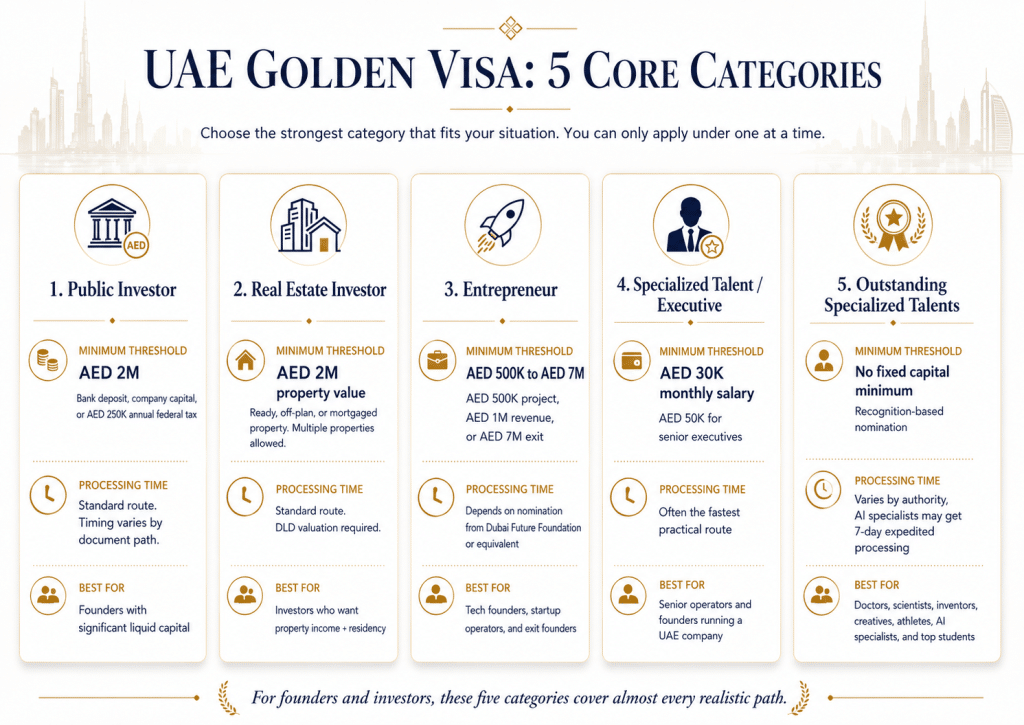
Choose the strongest category that fits your situation. You can only apply under one at a time.
The realistic application process (step by step)
This is the actual sequence. Total time: 15 to 30 days for most categories. 5 to 7 days for some routes. Up to 60 days for nomination-based categories.
Step 1: Confirm your category (Days 1 to 3)
Don’t apply under the wrong category. Spend a few days deciding. If you qualify under multiple categories, pick the one with the strongest documentation. Talk to a UAE-based immigration consultant before you commit. The AED 1,000 to AED 2,000 fee for a 1-hour consultation pays for itself by preventing a rejected application.
Step 2: Gather your documents (Days 4 to 10)
This is where most timelines slip. Required documents typically include:
- Valid passport with at least 6 months remaining
- Recent passport-sized photo (white background)
- Existing UAE residence visa or entry permit (if applicable)
- Health insurance valid for the visa period
- Bank statements (typically 6 months)
- Police clearance / good conduct certificate from home country
- Category-specific evidence (property title deed, trade license, employment contract, salary certificate, nomination letter, etc.)
- Attested educational certificates with UAE Ministry of Education equivalency (for talent/executive routes)
- Marriage certificate and children’s birth certificates (for family sponsorship)
All foreign documents need attestation from your home country’s Ministry of Foreign Affairs and the UAE Embassy in your home country, then again from the UAE Ministry of Foreign Affairs once they’re in the UAE. Plan 2 to 4 weeks for this if you haven’t done it already.
Step 3: Get pre-approval (Days 10 to 13)
For Dubai property investors, pre-approval from the Dubai Land Department comes first. For Abu Dhabi investors, it’s through the ICP. Other categories submit nomination letters from the relevant authority (Future Foundation, Ministry of Economy, Ministry of Culture, etc.) at this stage.
Step 4: Submit the application (Days 13 to 14)
Applications go through:
- ICP Golden Services Dashboard (icp.gov.ae) for Abu Dhabi and federal applications, accessed via UAE Pass.
- GDRFA smart services (gdrfad.gov.ae) for Dubai-specific applications.
- Dubai Land Department portal (dubailand.gov.ae) specifically for property investors.
You’ll create an account, complete the application form, upload all documents, pay fees electronically, and submit. The main fee is typically AED 2,800 to AED 4,500 plus a AED 100 knowledge fee. Family members pay separately.
Step 5: Get the entry permit (Days 14 to 17)
If approved, you’ll receive a 6-month multi-entry visa to enter the UAE (if applying from abroad) or to adjust status if already in the country. This is your gateway to the rest of the process.
Step 6: Medical fitness test (Days 17 to 20)
Visit a Dubai Health Authority (DHA) approved center. The test covers TB screening, HIV, and a chest X-ray. Cost: AED 370 to AED 700. Results are uploaded digitally to your portal within 24 hours.
Step 7: Biometrics and Emirates ID (Days 20 to 25)
Go to an Amer Center (Dubai) or ICP center (other emirates) for fingerprinting and an eye scan. Cost: AED 1,153 for the 10-year Emirates ID. Your card is typically delivered within 5 to 10 days.
Step 8: Receive your Golden Visa (Days 25 to 30)
Final approval comes via SMS and email. The visa is issued as a passport stamp or electronic visa. Validity is 10 years from the date of issue.
| Fastest realistic timelines by category
Property investor (Dubai, with bank financing): 15 days. Executive / talent (employed in UAE): 15 to 25 days. Entrepreneur (nomination required): 30 to 60 days. AI specialist (expedited): 7 days. Investor (capital deposit): 20 to 30 days. |
13 reasons applications get rejected (and how to avoid them)
The UAE rejects around 5 to 6 out of every 100 applications. Most rejections are preventable. These are the recurring issues we’ve seen and that immigration consultants flag most often.
Documentation issues (most common)
- Expired documents. Passport with less than 6 months validity, expired Emirates ID, expired trade license. Always check validity 1 month before applying.
- Missing degree attestation. Foreign degrees need attestation from your home country’s Ministry of Foreign Affairs and the UAE Embassy. Then equivalency through the UAE Ministry of Education. Skip this and you’ll get an automatic rejection on talent or executive routes.
- Inconsistent personal information. Names spelled differently across passport, marriage certificate, and visa application. Date of birth mismatches. These flag automatic verification failures.
- Missing nomination letter. For talent, entrepreneur, and outstanding specialist categories, the nomination from the relevant UAE authority is mandatory. No letter, no approval.
Eligibility miscalculations
- Property valuation below AED 2 million on the DLD. Contract price doesn’t matter. The DLD valuation does. Always get a property status statement first.
- Property outside designated freehold zones. Only properties in zones where foreign ownership is permitted qualify. Verify before purchase.
- Joint ownership share below AED 2 million. If you own a property jointly, your share alone must hit the threshold. Two people each owning AED 1 million of a AED 2 million property does not qualify.
- Job title doesn’t match MOHRE Level 1 or 2. If your employment contract says “Consultant” or “Specialist” without specifics, the application gets rejected. Update your contract before applying if your role qualifies but your title doesn’t reflect it.
- Salary not paid through WPS or salary description unclear on bank statements. Your monthly transfer needs to clearly say “Salary” with the amount above AED 30,000. Random transfers won’t count.
Compliance and history issues
- Unresolved immigration violations. Old overstay fines, unresolved cancellations, visa bans (even from years ago). Check your status through GDRFA or ICA before applying.
- Criminal record or security flag. Even minor incidents that are years old can flag you. If you have anything in your history, get a police clearance certificate showing it’s resolved before you apply.
- No health insurance for dependents. Required for the main applicant AND every dependent. Coverage has to be valid in the UAE.
- Insufficient evidence under “exceptional talent.” If you’re applying under outstanding specialist routes (artist, athlete, content creator), you need real evidence: awards, recognition, published work, verified impact. A LinkedIn bio isn’t enough.
How to actually avoid all of this
Two practical moves cut rejection risk dramatically. First, use a UAE-licensed immigration consultant. They charge AED 5,000 to AED 15,000 and approve at a much higher rate than self-filed applications. Second, before you submit, get a second pair of eyes to cross-check your documents for consistency. Wrong middle name, transposed date digits, mismatched spellings. These small things kill applications more often than eligibility gaps do.
After you get the Golden Visa
Approval isn’t the finish line. There are ongoing requirements to keep your visa valid.
What you have to maintain
- Valid UAE health insurance for yourself and dependents
- Active qualifying investment (property held, deposit maintained, business operating)
- Clean immigration and legal record
- Updated personal information with authorities (address changes, marital status, etc.)
What you can do immediately
- Sponsor family members (spouse, children, parents)
- Open a UAE bank account at any institution
- Apply for a UAE driver’s license
- Sign 12-month lease agreements
- Register your children in schools
- Apply for a Dubai PRO card, EID services, and digital government tools through UAE Pass
What still requires work
The Golden Visa doesn’t automatically make you a UAE tax resident. To claim UAE tax residency for double-taxation treaty purposes, you typically need to be physically present in the UAE for at least 183 days per tax year, or 90 days if you have a permanent home there and primary economic/personal interests in the UAE.
If you’re planning around tax residency, talk to a UAE-licensed tax consultant. For the full picture on UAE corporate tax, free zone QFZP rules, and personal tax implications, see our pillar guide on moving to Dubai.
| Meet immigration advisors face-to-face at PlanX 2026
IMI Pro Partner, a leading global investment migration firm, is on the floor at PlanX 2026 in November. So are tax structurers, citizenship-by-investment specialists, and the founders who’ve actually navigated the Golden Visa process. The fastest way to get specific answers to your specific situation. |
Golden Visa vs other long-term residencies
The Dubai Golden Visa is often compared against Portugal’s D7, Malta’s Golden Residence, Singapore’s GIP, and the US E-2 treaty visa. Quick honest comparison:
| Program | Min Investment | Duration | Tax (residents) | Time to issue |
| UAE Golden Visa | AED 2M (~$545K) | 10 years | 0% personal | 15 to 30 days |
| Portugal D7 | Passive income proof | 5 years to PR | Up to 48% | 4 to 6 months |
| Malta Golden Residence | €100K+ donation | 5 years | Up to 35% | 4 to 6 months |
| Singapore GIP | SGD 10M+ (~$7.4M) | 5 years | Up to 24% | 9 to 12 months |
| Greece Golden Visa | €250K to €800K | 5 years | Up to 44% | 2 to 4 months |
On the math alone, the Dubai Golden Visa wins on tax efficiency, residency duration, and speed. Where other programs win is EU access (Malta, Portugal, Greece) or pathways to a strong second passport. None of those are why founders typically pick Dubai. They pick Dubai for tax, founder density, and global positioning.
FAQ: Dubai Golden Visa
Can I apply for a Golden Visa from outside the UAE?
Yes. Most categories accept applications from abroad through the ICP portal. You’ll receive a 6-month entry visa once approved, then complete the rest of the process (medical, biometrics, Emirates ID) inside the UAE.
Do I need to live in the UAE to keep the Golden Visa?
No. Golden Visa holders are exempt from the 180-day rule that applies to standard residency. You can live outside the UAE indefinitely without losing your status, as long as you maintain the qualifying investment or category requirements.
Can my parents come with me on a Golden Visa?
Yes. Golden Visa holders can sponsor parents on a single family application. You’ll need to prove dependency. The visa duration for sponsored parents matches the main applicant (typically 10 years).
What happens if I sell my qualifying property?
Your Golden Visa is tied to the qualifying investment. If you sell the property and don’t replace it with another qualifying investment, your visa can be canceled at renewal. You’re typically required to maintain the qualifying asset throughout the visa term.
Can I work for someone else’s company on a Golden Visa?
Yes. Unlike standard employer-sponsored visas, the Golden Visa is self-sponsored. You can work for any UAE employer, run multiple businesses, or do consulting work. The visa isn’t tied to a single employer.
Is the Golden Visa transferable to a different country?
No. It’s a UAE residency permit. It does not grant residency or citizenship in any other country.
Can I get a Golden Visa through a friend’s company if I’m a partner?
Yes, under the entrepreneur or investor categories. Your partnership share must independently meet the threshold (AED 2M+ capital share for investor, or AED 500K+ project value for entrepreneur). The company’s MOA and audited financials need to clearly show your stake.
What if my application gets rejected? Can I reapply?
Yes, in most cases. Once you’ve identified and fixed the rejection reason (missing document, wrong category, incorrect job title), you can reapply. Some rejections related to security, criminal records, or non-negotiable legal restrictions are final.
How long does renewal take?
Renewal is typically faster than initial application: 7 to 14 days for most categories, provided the qualifying investment or eligibility criteria are still met. You can renew up to 6 months before expiry.
Does the Golden Visa make me a UAE tax resident automatically?
No. Tax residency depends on physical presence and economic ties, not visa status alone. The general rule is 183 days of physical presence per tax year, or 90 days with a permanent home and primary interests in the UAE. Talk to a tax advisor if you’re planning around this.
Can crypto holdings count toward the AED 2 million investment threshold?
Not directly. Cryptocurrency itself is not currently accepted as a qualifying asset. However, converted cash deposited in a UAE bank, or proceeds invested in UAE real estate, do qualify. The funds need to be in an approved form once they reach the UAE.
What’s the difference between the Dubai Golden Visa and the federal UAE Golden Visa?
They’re the same program. The Federal Authority (ICP) administers it nationally. Dubai handles its own applications through GDRFA. Other emirates apply through ICP directly. Eligibility criteria are largely federal, but emirate-specific processes (Dubai property routes, for example) have local steps.
The bottom line
The Dubai Golden Visa is the most accessible high-tier residency program in the world right now. The math works, the process is faster than every comparable alternative, and recent rule changes have made it more achievable than at any point since launch.
The applicants who get rejected mostly do so for preventable reasons: document mismatches, missing attestations, wrong category selection, or property valuations that don’t meet the threshold. Spend AED 5,000 to AED 15,000 on a proper UAE-licensed immigration consultant. It pays for itself by preventing a rejected application.
The applicants who win move quickly once they qualify. The 10-year stability, the family coverage, and the ability to operate from a 0% personal tax jurisdiction with a strong global passport are real advantages that compound over time.
If you’re still working through whether Dubai is the right move at all, start with our complete founder’s guide to moving to Dubai. If you’ve already decided and you want to plug into the network, PlanX 2026 is where the founders, investors, and advisors actually meet.
| PlanX 2026: where the Dubai network actually meets
Two days, 2,500 founders, four tracks. Wealth, Growth, Leverage, Network. Including IMI Pro Partner and the tax structurers who specialize in UAE residency. November 25 to 26 at Grand Hyatt Dubai. Super Early Bird saves $400. |