The honest 2026 comparison founders need before incorporating in Dubai. Setup costs, corporate tax reality, ownership rules, banking, and the one mistake that costs founders the most.

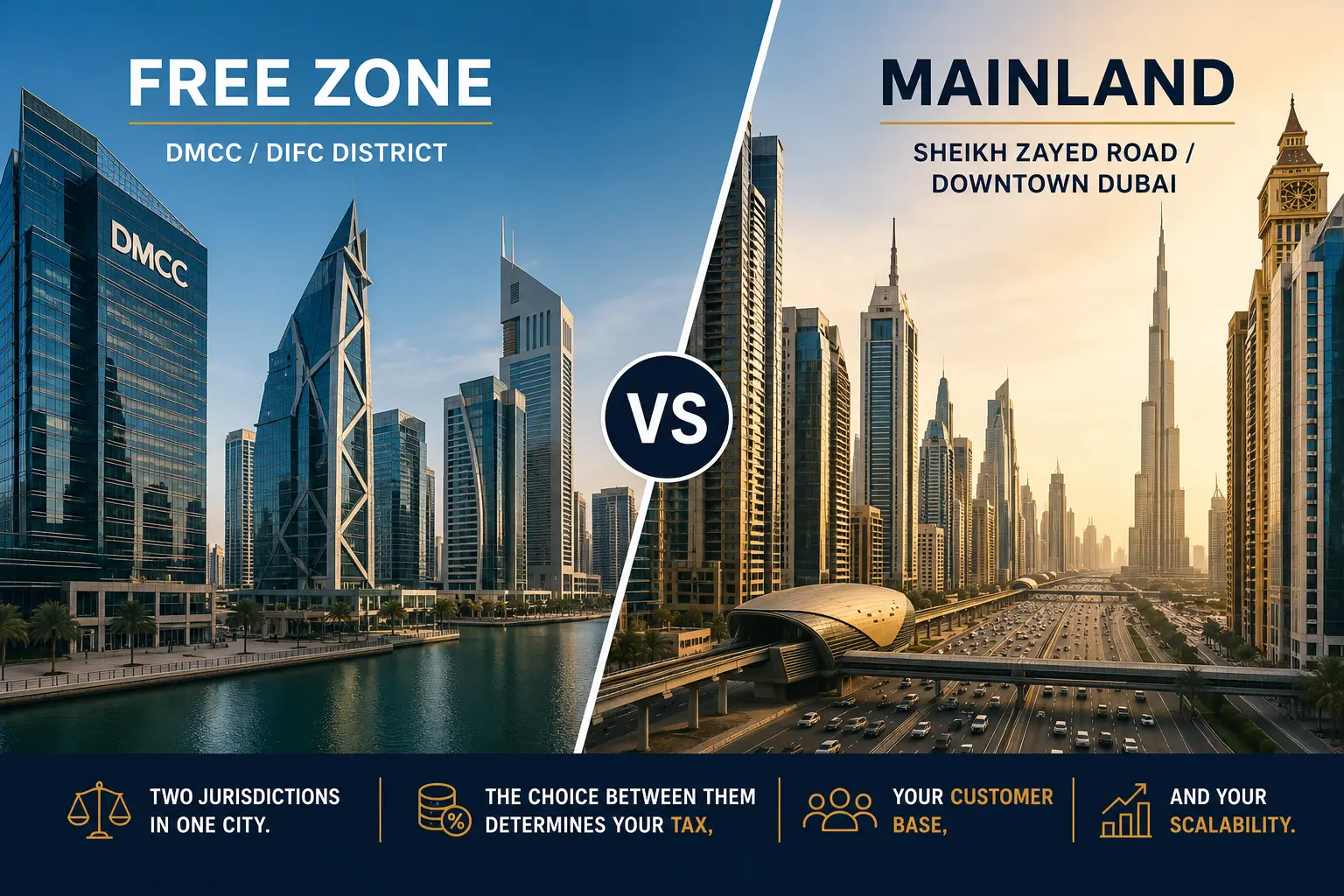
Two jurisdictions in one city. The choice between them determines your tax, your customer base, and your scalability.
Almost every founder we work with at PlanX asks the same question within a week of deciding to move to Dubai: free zone or mainland? Most of them get bad advice.
The bad advice usually sounds like one of two things. “Always go free zone, it’s cheaper and tax-free.” Or “Go mainland, free zones can’t trade in Dubai.” Both statements are partly true and mostly misleading. The right answer depends entirely on who pays you, what you sell, and where you want the business in five years.
This post is the direct comparison. Setup cost, corporate tax under the 2026 QFZP rules, ownership, banking, visa quota, and the operational realities you only learn after incorporating. By the end you’ll know which structure fits your business and what the wrong choice actually costs.
If you’re earlier in your journey and still deciding whether to move at all, start with our complete founder’s guide to moving to Dubai. If you’ve decided and you’re working through the visa question, see the Dubai Golden Visa Playbook. This piece picks up after both: how to structure the business itself.
| Not sure structure is your real bottleneck?
Founders spend weeks debating free zone vs mainland when the actual bottleneck is somewhere else entirely. Take the 2-minute Founder Bottleneck assessment first. It shows you where your business is genuinely limited right now. Then come back and decide on structure with more clarity. |
The 30-second answer (read this first)
If you only have 30 seconds, here’s the operational decision rule we’ve watched founders use successfully:
| Pick free zone if
Your customers are mostly outside the UAE. You sell digital services, software, consulting, or you run a holding/IP structure. You want fast setup and lower entry cost. You’re comfortable with the QFZP compliance work to keep 0% tax on qualifying income. |
| Pick mainland if
Your customers are mostly inside the UAE. You sell to UAE businesses or consumers, run physical retail, food and beverage, clinics, schools, or you want to bid for government contracts. You’re willing to pay more upfront for broader market access. |
The rest of this post is the detail behind that decision.
What each structure actually is
Free zone (operates under independent free zone authority)
A free zone company is licensed by an independent free zone authority. Dubai has more than 40 of them. Examples: DMCC, IFZA, Meydan, DIFC, JAFZA, Dubai Internet City, Dubai Multi Commodities Centre. Each zone has its own regulator, its own licensing process, and its own rules around permitted business activities.
Free zone companies have always offered 100% foreign ownership. That used to be the main reason to choose them. After the 2021 Commercial Companies Law amendment, that advantage no longer exists, since mainland companies can also be 100% foreign-owned in most sectors. Free zones are now mainly chosen for cost-efficiency, speed, and tax structuring.
Key constraint: a free zone company cannot trade directly with UAE mainland customers without going through a distributor or opening a mainland branch. This single rule shapes the entire decision.
Mainland (licensed by Dubai Department of Economy and Tourism)
A mainland company is licensed by the Dubai Department of Economy and Tourism (DET), formerly the Department of Economic Development. It’s the standard onshore corporate entity, governed by the UAE Commercial Companies Law. Since the 2021 amendment, mainland businesses in over 1,000 commercial and industrial activities can be 100% foreign-owned without a local Emirati partner.
A mainland company can trade anywhere in the UAE, sell directly to consumers and businesses, run physical premises (retail, F&B, clinics, schools), bid for government contracts, and operate across all seven emirates. The main constraint is that it requires a physical office leased through Ejari, which is mandatory and adds materially to the setup cost.
| The 2021 ownership change that most articles still misrepresent
Before 2021, mainland companies required a UAE national to hold 51% of shares. This was the historical reason most foreigners chose free zones. The 2021 amendment removed this requirement for over 1,000 commercial and industrial activities. A short list of strategic-impact activities (oil and gas, defence, certain utilities) still requires local participation. If you’re reading content from 2020 or earlier claiming mainland requires a local partner, ignore it. |
Head to head: the 8 factors that actually matter
This is the comparison most founders need. Eight dimensions, side by side, with the 2026 reality on each.
1. Setup cost (free zone wins)
Free zone realistic 2026 cost: AED 12,000 to AED 30,000 for first-year setup. That covers license, flexi-desk, and basic visa allocation. Some zones (Meydan, IFZA) have entry packages starting around AED 5,750 for zero-visa licenses.
Mainland realistic 2026 cost: AED 15,000 to AED 35,000 for the license itself. Then add AED 25,000 to AED 60,000 a year for an Ejari-registered office, which is mandatory. All-in first-year mainland cost typically runs AED 50,000 to AED 100,000 or more depending on activity and office choice.
Founder takeaway: free zone is roughly 2x to 4x cheaper for first-year setup. If runway matters and your customers aren’t UAE-based, this difference compounds across the early years.
2. Setup speed (free zone wins by a wide margin)
Free zone licenses can be issued in 1 to 14 days depending on the zone. The fastest (Meydan, IFZA) issue licenses in 1 to 5 business days. DMCC typically takes 7 to 10 days. DIFC takes 14 to 30 days because of the higher compliance and regulatory standard.
Mainland DET licenses take 2 to 3 weeks for standard activities. Specialist activities (healthcare, education, financial services) can take 4 to 8 weeks because they require approvals from multiple regulators in addition to DET.
Founder takeaway: if you need to move fast, free zone. If you’re patient enough to wait a month, the speed difference doesn’t matter much.
3. Ownership and structure (now equal in most cases)
Both can be 100% foreign-owned in 2026. Free zones always allowed this. Mainland allows it for over 1,000 commercial and industrial activities since 2021. The historical reason to pick free zone over mainland has disappeared in most cases.
Exceptions still requiring local participation on the mainland: oil and gas, certain defence and security activities, specific utilities. If you’re not in those sectors, ownership is no longer a differentiator.
4. Market access (mainland wins)
This is the most underweighted factor and the one that costs founders the most when they pick wrong.
Free zone: cannot directly trade with UAE mainland customers. To sell to a UAE business or consumer, you either need a local distributor (who takes 10 to 25 percent margin), or you open a mainland branch separately, or you classify the sale as cross-border with the customer importing from your free zone.
Mainland: can sell directly anywhere in the UAE. Can also sell internationally. No restrictions on who you can invoice.
Founder takeaway: if 30 percent or more of your revenue will come from UAE customers, the distributor margin you’d pay as a free zone company often exceeds the higher mainland setup cost within the first year. We’ve seen founders set up DMCC for cost reasons, sign three UAE clients, and then pay the equivalent of a full mainland office cost in distributor commissions in year one.
5. Corporate tax under 2026 rules (depends on QFZP compliance)
This used to be the easy win for free zones. After June 2023 and the QFZP framework, it’s much more nuanced.
Mainland: 9% corporate tax on taxable profit above AED 375,000. Below that threshold, 0%. Standard treatment under Federal Decree-Law No. 47 of 2022.
Free zone: can achieve 0% corporate tax on qualifying income if the company meets all five Qualifying Free Zone Person (QFZP) conditions. Income that doesn’t qualify is taxed at 9%.
The five QFZP conditions, updated under Ministerial Decision No. 229 of 2025:
- Adequate substance in the free zone. Real staff, real expenses, real management decisions in the UAE. Not a shell.
- Qualifying income only. Income from international trade, transactions with other free zone entities, or approved qualifying activities.
- De minimis test. Non-qualifying revenue cannot exceed the lower of AED 5 million or 5% of total revenue.
- No election for standard tax regime. You haven’t opted to be taxed under the standard mainland rules.
- Transfer pricing compliance and audited IFRS financials. Required from tax year 2025 onwards.
| The penalty for failing QFZP conditions is severe
If a free zone company fails any one of the five QFZP conditions, it loses its 0% qualifying-income treatment. All income gets taxed at 9% for that year AND for the next four tax years. You cannot retest until year six. This is a 5-year lockout period that catches many founders unprepared. |
Practical 2026 reality: a free zone company that does its QFZP compliance well can still operate at 0% on qualifying income. A free zone company that treats its license as automatic tax-free status will get caught when the Federal Tax Authority audits it. The FTA is now reviewing first-wave full-year returns and asking pointed questions about substance and revenue classification.
Founder takeaway: free zone still wins on tax if you operate genuinely, internationally, and at scale. Mainland makes more sense if your business has significant UAE customers or you can’t justify the QFZP compliance overhead.
For the full QFZP technical breakdown, the PwC Tax Summary for the UAE is the most accurate reference in 2026.
6. Visa allocation (mainland wins for scaling teams)
Each free zone has a visa quota tied to your office size. Flexi-desks typically allow 1 to 6 visas. A larger office or a serviced office can support more. Some zones (DMCC) allow up to 25 visas per company without additional office space if you’re in their executive suite or co-working tiers.
Mainland: visa quota is tied to your Ejari-registered office space, calculated at roughly 9 square meters per visa. A 100 square meter office supports approximately 11 visas. There’s no fixed cap. You can scale to 50+ visas by leasing more space.
Founder takeaway: if you’re hiring more than 8 to 10 people, mainland gives you more flexibility. If you’re a small remote team or a holding company, free zone visa quotas are usually fine.
7. Banking (slight edge to mainland in 2026)
UAE banks have de-risked aggressively since 2023. Both free zone and mainland companies can open accounts, but the experience differs.
Free zone companies: accepted by all major banks. Some banks may ask for additional documentation, business plan, or proof of operations. Digital-first businesses face more scrutiny than they did before 2023. Account opening: 3 to 8 weeks at tier-one banks (Emirates NBD, ADCB, FAB, HSBC UAE). 1 to 2 weeks at neobanks (Wio, Mashreq NeoBiz).
Mainland companies: slightly easier approval, especially for high-volume trading businesses and businesses serving UAE customers. Same 3 to 8 week timeline at tier-one banks but with fewer rejections.
Founder takeaway: this is not the decisive factor most founders think it is. Bank approval depends more on your business model, source of funds, and documentation than on free zone vs mainland. That said, if your business looks unusual (crypto, web3, online gaming, certain consulting), mainland tends to face fewer questions.
8. Compliance overhead (free zone is heavier in 2026)
This is the area where the math has shifted most since 2023.
Mainland: standard corporate tax registration, annual returns, VAT registration above AED 375,000 turnover, ESR filings for relevant activities, Ejari renewals. Predictable, well-understood.
Free zone (QFZP): all of the above PLUS audited IFRS financial statements (required from 2025), transfer pricing documentation, substance evidence, careful revenue classification to maintain QFZP eligibility, and ongoing monitoring of the de minimis threshold. Audit fees alone typically add AED 8,000 to AED 25,000 per year on top of regular accounting.
Founder takeaway: the 0% QFZP tax saving needs to be material enough to justify the extra compliance work. For a free zone company with AED 500K in qualifying income, you’d save AED 11,250 in tax (9% of AED 125K above the AED 375K threshold) but spend AED 15,000+ on the audit and compliance. The math only works above a certain revenue scale.

The 8 factors that actually determine the right choice for your business.
Side-by-side: 2026 numbers
| Factor | Free Zone | Mainland |
| Setup cost (Year 1) | AED 12,000 to 30,000 | AED 50,000 to 100,000+ |
| License only | AED 5,750 to 25,000 | AED 15,000 to 35,000 |
| Office requirement | Flexi-desk OK | Ejari office mandatory |
| Foreign ownership | 100% | 100% (most sectors) |
| Setup time | 1 to 14 days | 2 to 8 weeks |
| UAE customer access | Through distributor only | Direct, anywhere in UAE |
| Government contracts | No | Yes |
| Corporate tax (qualifying income) | 0% (if QFZP) | 9% above AED 375K |
| Corporate tax (non-qualifying) | 9% | 9% above AED 375K |
| Visa quota | Tied to office, 1 to 25 | Tied to office size, no cap |
| Audited financials required | Yes (from 2025) | Above AED 50M turnover |
| Compliance overhead (annual) | AED 15,000 to 40,000 | AED 5,000 to 20,000 |
Cost figures reflect typical 2026 ranges across multiple Dubai providers. Specific zones and activities vary. The compliance overhead estimate for free zones includes audit fees, transfer pricing documentation, and QFZP advisory work.
If you go free zone: picking the right one matters as much as the structure choice
Dubai has over 40 free zones. They are not interchangeable. The wrong free zone can be as bad as picking free zone when you should have picked mainland. Quick orientation:
DMCC (Dubai Multi Commodities Centre)
Consistently ranked the world’s number one free zone for trading. Strong for general trading, commodities, services, and crypto businesses (with VARA approval). Setup cost: AED 25,000 to AED 50,000 first year. Robust ecosystem with 25,000+ companies and high credibility with banks. Good for founders prioritizing reputation and access.
DIFC (Dubai International Financial Centre)
The financial services hub. Common law jurisdiction (independent of UAE federal law for civil and commercial matters), English-language courts, and globally-respected regulator (DFSA). Setup cost: AED 30,000 to AED 100,000+ depending on activity. Required for asset management, fund structures, fintech with regulatory exposure, and family offices. Overkill for general business.
IFZA (International Free Zone Authority)
Lowest-cost general services option. Entry packages start around AED 12,000. Good for small consultancies, digital services, and early-stage operators. Less banking-friendly than DMCC but workable. Best for founders prioritizing cost over reputation.
Meydan Free Zone
Fast setup (1 to 5 days), tax-efficient, well-positioned for digital businesses. Lower compliance burden than DMCC for similar activities. Setup cost: AED 12,500 to AED 30,000. Strong for SaaS, e-commerce, content businesses.
Dubai Internet City / Dubai Media City
Tech and media specialists. Stronger ecosystem signal for tech founders. Setup costs roughly equivalent to DMCC.
JAFZA (Jebel Ali Free Zone)
Best for physical trading, logistics, manufacturing, warehousing. Located near Jebel Ali port. Higher entry cost but access to UAE’s biggest port infrastructure. Setup cost: AED 30,000 to AED 90,000.
Founder takeaway: a generalist consultancy or digital business is well-served by DMCC, IFZA, or Meydan. A fintech, asset manager, or fund is almost always DIFC. A physical trader is JAFZA. Picking the wrong zone within the free zone category is a common but expensive mistake.
Why founders re-structure (and the cost of getting it wrong)
In our community we regularly see founders re-incorporate after 12 to 24 months because their initial structure didn’t fit how the business actually evolved. The pattern is predictable.
Pattern 1: Free zone founder discovers UAE customers
Founder sets up in DMCC for the cost-efficiency and 0% tax. Twelve months later, three UAE clients have signed up. The founder is now paying distributor commissions of 12 to 20 percent, or trying to route invoices through awkward cross-border workarounds, or losing deals to mainland competitors who can invoice directly.
Cost to fix: open a mainland branch of the free zone company. Roughly AED 30,000 to AED 50,000 plus ongoing dual compliance. Or liquidate the free zone entity and re-incorporate mainland. Higher cost.
Pattern 2: Mainland founder pays unnecessary tax for years
Founder sets up mainland because “it sounded more legitimate.” Business is 95 percent international clients. Founder pays 9% on AED 2 million of profit (AED 180,000 per year in tax) that a properly-structured QFZP would have taxed at 0% on most of.
Cost to fix: liquidate mainland entity, set up in a free zone with proper QFZP compliance from the start. Year of dual operations, AED 30,000 to AED 60,000 in restructuring costs. But the tax saving from year two onwards is real.
Pattern 3: Free zone founder fails QFZP, loses 0% for 5 years
Founder operates from a free zone but neglects substance, audited accounts, or transfer pricing documentation. FTA audits the company and disqualifies QFZP status. All income from the audit year and the next four years is taxed at 9%. On a business doing AED 5 million in profit, that’s roughly AED 2.1 million in tax over the lockout period (factoring the AED 375K threshold).
This is increasingly common in 2026 because the FTA is now reviewing first-wave returns systematically.
Cost to fix: nothing, until the lockout ends. Pay the tax and get compliant for next time.
The lesson across all three: spend AED 5,000 to AED 10,000 on a proper tax consultant before incorporating. The downstream cost of getting structure wrong is 10x to 50x that.
| Meet tax structurers face-to-face at PlanX 2026
Tax consultants and structuring specialists, including IMI Pro Partner, are on the floor at PlanX 2026 in November. They’ve helped hundreds of founders get the free zone vs mainland decision right the first time. The fastest way to get specific answers for your specific situation. |
Decision framework: which one fits your business
Cut through the noise with three questions:
Question 1: What percent of your revenue comes from UAE customers?
Under 30%: free zone is almost always better. Above 50%: mainland is almost always better. Between 30 and 50%: run the math both ways including distributor commissions.
Question 2: Will you maintain real substance in the UAE?
Real substance means: full-time employees in the UAE (not just visa holders living abroad), real office presence, real operating expenses, decisions made locally.
If yes: free zone QFZP works and the 0% tax saves real money. If no: mainland is simpler and avoids the 5-year lockout risk.
Question 3: Are you scaling beyond 10 employees in year one or two?
If yes: mainland gives more visa flexibility, fewer office constraints, and an easier path to a larger UAE-based team. If no: free zone is fine and cheaper.
Two yes answers to these three questions usually points clearly in one direction. Three yes answers makes it obvious.
Common mistakes founders make
1. Picking based on the lowest setup cost
Saving AED 30,000 on incorporation is meaningless if you lose AED 200,000 in distributor commissions or unnecessary tax in year one. The setup cost is the smallest factor in the decision. Most founders weight it too heavily.
2. Assuming free zone equals tax-free
Free zone equals 0% tax ONLY on qualifying income AND only if the company meets all five QFZP conditions. A free zone shell without substance is not tax-free. It’s taxed at 9% with a 5-year lockout penalty waiting.
3. Picking the wrong free zone within the category
A fintech in DMCC is at a disadvantage. An e-commerce store in DIFC is overpaying. A consultancy in JAFZA is in the wrong physical location. Pick the right zone for your specific activity.
4. Ignoring the cost of distributor margins
Founders who serve UAE clients through a free zone often forget that distributor margins are real money. 15% commission on AED 2 million of UAE revenue is AED 300,000 per year. That funds a mainland office five times over.
5. Listening to the consultant who profits from your choice
Setup consultants and PROs get commissions from the free zone authorities they recommend. Some are excellent and unbiased. Many will steer you toward the zone that pays them the highest commission, not the one that fits your business. Ask your consultant directly: do you receive commission from this zone? If yes, get a second opinion.
6. Not factoring the 5-year QFZP lockout into risk
Free zone founders often don’t realize that losing QFZP status isn’t a one-year problem. It’s a 5-year tax penalty. For a profitable business, this is the single biggest financial risk in the structure decision.
FAQ: Dubai Free Zone vs Mainland
Can I change from free zone to mainland later?
Not directly. You cannot convert one to the other. You would either liquidate the existing entity and re-incorporate, or open a mainland branch of the free zone company (which means dual compliance). Either path costs AED 30,000 to AED 60,000 plus time.
Can a free zone company sell to UAE customers at all?
Yes, but indirectly. You can sell through a distributor (who handles the customer relationship and takes a margin), or through a mainland branch you open separately, or by classifying the transaction as cross-border (the customer imports from your free zone). Direct trading with mainland UAE customers without one of these structures is not permitted under most free zone licenses.
Does free zone really give 0% corporate tax?
Only on qualifying income, and only if all five QFZP conditions are met (adequate substance, qualifying income, de minimis test, no mainland election, transfer pricing compliance with audited financials). Non-qualifying income within a free zone company is taxed at 9%. Free zone is not automatically tax-free.
Which free zones are best for tech founders?
DMCC for general tech and software. Dubai Internet City and Dubai Silicon Oasis for tech specialists. DIFC for fintech and regulated financial technology. Meydan for digital-first businesses prioritizing cost and speed.
Which free zones are best for consultants?
IFZA for the lowest cost. Meydan for speed. DMCC for credibility with international clients. DIFC if you serve regulated financial services clients.
Can I have a free zone company AND a mainland company simultaneously?
Yes, this is a common structure. Many founders run a free zone holding or international services company alongside a mainland operating company for UAE customers. The two entities maintain separate accounts, licenses, and tax positions.
What happens if my free zone company exceeds the de minimis revenue threshold?
If non-qualifying revenue exceeds the lower of AED 5 million or 5% of total revenue, your company loses QFZP status for that tax year and the next four years. All income gets taxed at 9% above AED 375,000 during the lockout. Monitor revenue classification monthly, not annually.
Do I need to be physically in Dubai to run a free zone company?
Technically no, but practically yes if you want QFZP status. Adequate substance requires real management presence, qualified employees, and operational decisions in the UAE. Founders running free zone shells from abroad are increasingly being flagged in FTA audits.
How long does mainland setup actually take in 2026?
Standard commercial activities: 2 to 3 weeks from application to license. Add 1 to 2 weeks for visa and Emirates ID processing. Specialist activities requiring multi-agency approvals (healthcare, education, financial services): 4 to 8 weeks. Add another month if you need MOFA or external approvals.
Can I get a Golden Visa through a free zone company?
Yes. Both the investor and entrepreneur Golden Visa categories accept free zone companies. The qualifying threshold (AED 2M capital for investor, AED 1M revenue or AED 500K project value for entrepreneur) is the same regardless of jurisdiction.
What’s the cheapest way to test the UAE market before committing?
A freelance or self-employment visa in a free zone like GoFreelance (TECOM) costs AED 7,500 to AED 13,000 first year. It gives you a residence visa, Emirates ID, and the ability to invoice clients while you decide whether to commit to a full company structure.
If my business serves only international clients, is mainland ever a good choice?
Rarely. For purely international service businesses, free zone QFZP saves significant tax and the mainland’s market access advantages are wasted. The exception: if you need a larger office for staff or you cannot maintain QFZP compliance, mainland may be simpler operationally even at the higher tax rate.
The bottom line
Free zone vs mainland is a business model question, not a tax question. Picking based on cost or assumed tax benefits without thinking about your customers is how founders end up paying for the wrong structure twice.
Rule of thumb: if your customers are mostly outside the UAE and you’ll maintain real operations in Dubai, free zone with proper QFZP compliance is the right choice. If your customers are mostly inside the UAE or you’re running a physical business locally, mainland is the right choice. If you’re between the two, the additional cost of mainland is usually less than the distributor commissions and structural workarounds you’d face as a free zone.
The single best move before incorporating: spend AED 5,000 to AED 10,000 on a proper UAE tax and corporate structuring consultant. It’s the highest-ROI advice you can buy at this stage of the journey.
If you’re working through the full relocation picture, start with our pillar guide on moving to Dubai. For the residency angle, see the Dubai Golden Visa Playbook. And if you want to meet the structurers and operators who can answer your specific situation, PlanX 2026 is where the Dubai founder ecosystem gathers in November.
| PlanX 2026: where structure questions get real answers
Two days, 2,500 founders, four tracks. Wealth, Growth, Leverage, Network. Including tax structurers, IMI Pro Partner, and the founders who’ve actually navigated free zone vs mainland decisions at scale. November 25 to 26 at Grand Hyatt Dubai. Super Early Bird saves $400. |