Seven illustrative scenarios showing how 7-figure founders in the Dubai ecosystem deploy AI to scale, grounded in verified 2026 adoption benchmarks. Real patterns, realistic results, and what you can copy.
| Written by the PlanX team • Last updated: June 2026 • Composite scenarios grounded in verified 2026 AI adoption benchmarks |
| ABOUT THESE CASE STUDIES
The seven scenarios below are illustrative composites, not profiles of specific individuals. Each one is built from common patterns we see across the founder community and is grounded in verified 2026 AI adoption benchmarks from sources including BizBuySell, the SBE Council, Thunderbit, and Enrich Labs. Results are presented as realistic ranges based on those benchmarks, not as guaranteed outcomes. Your results will vary based on your business, your implementation, and your market. We use composites so we can show the full pattern clearly without exposing any individual founder’s private business data. |
| QUICK ANSWER
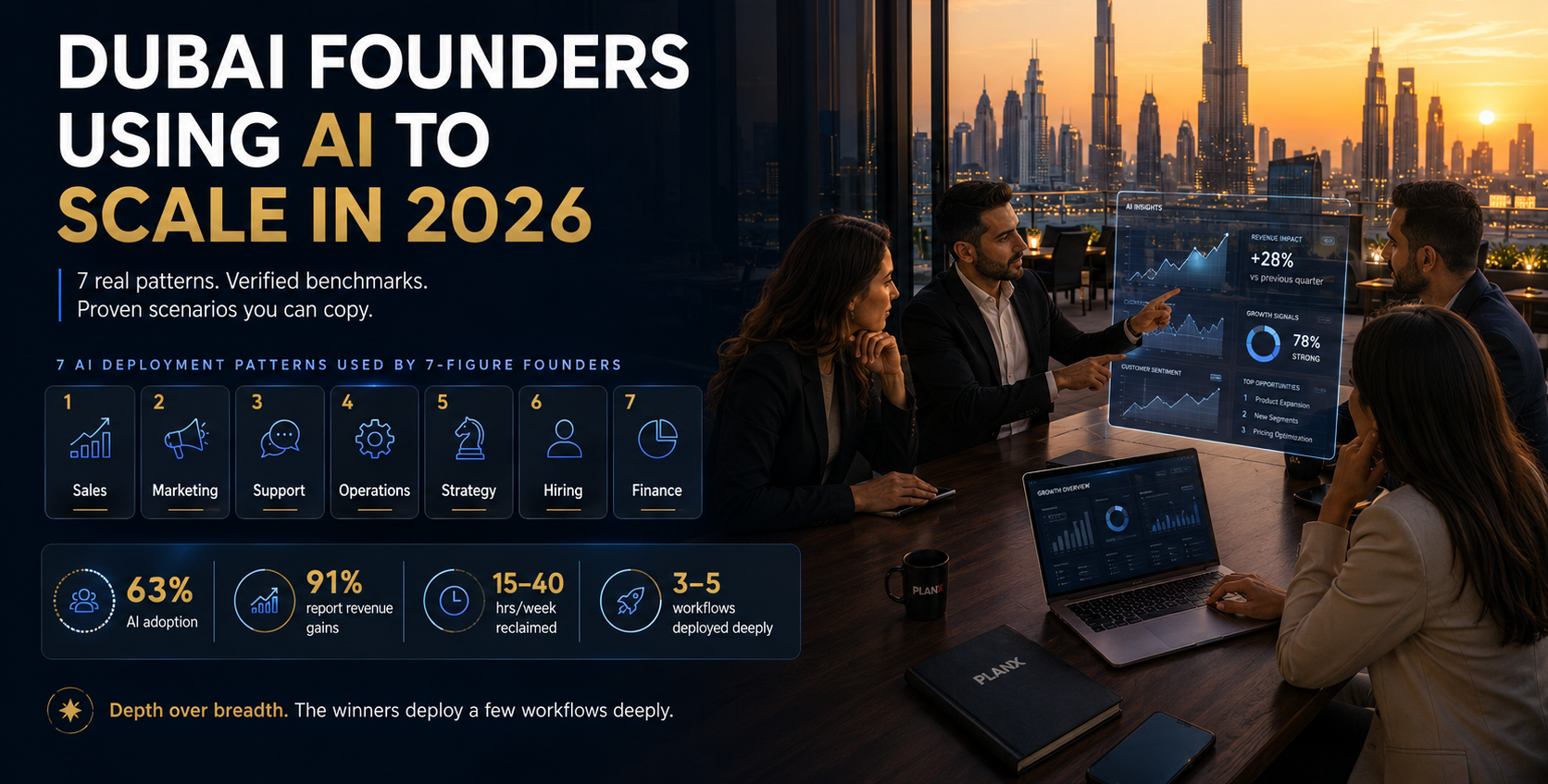
Dubai founders are using AI in 2026 across seven main areas: sales pipeline acceleration, marketing content production, customer support automation, operational workflows, strategic decision-making, hiring, and financial reporting. The common pattern is depth over breadth: the founders seeing the biggest gains deploy 3 to 5 AI workflows well rather than chasing every new tool. Grounded in 2026 benchmarks, founders who do this typically reclaim 15 to 40 hours per week, improve sales conversion 15 to 30%, and run marketing at the level of a full team. The differentiator is not which tools they use but how systematically they deploy them. |
| Dubai Founders and AI in 2026: Key Benchmarks
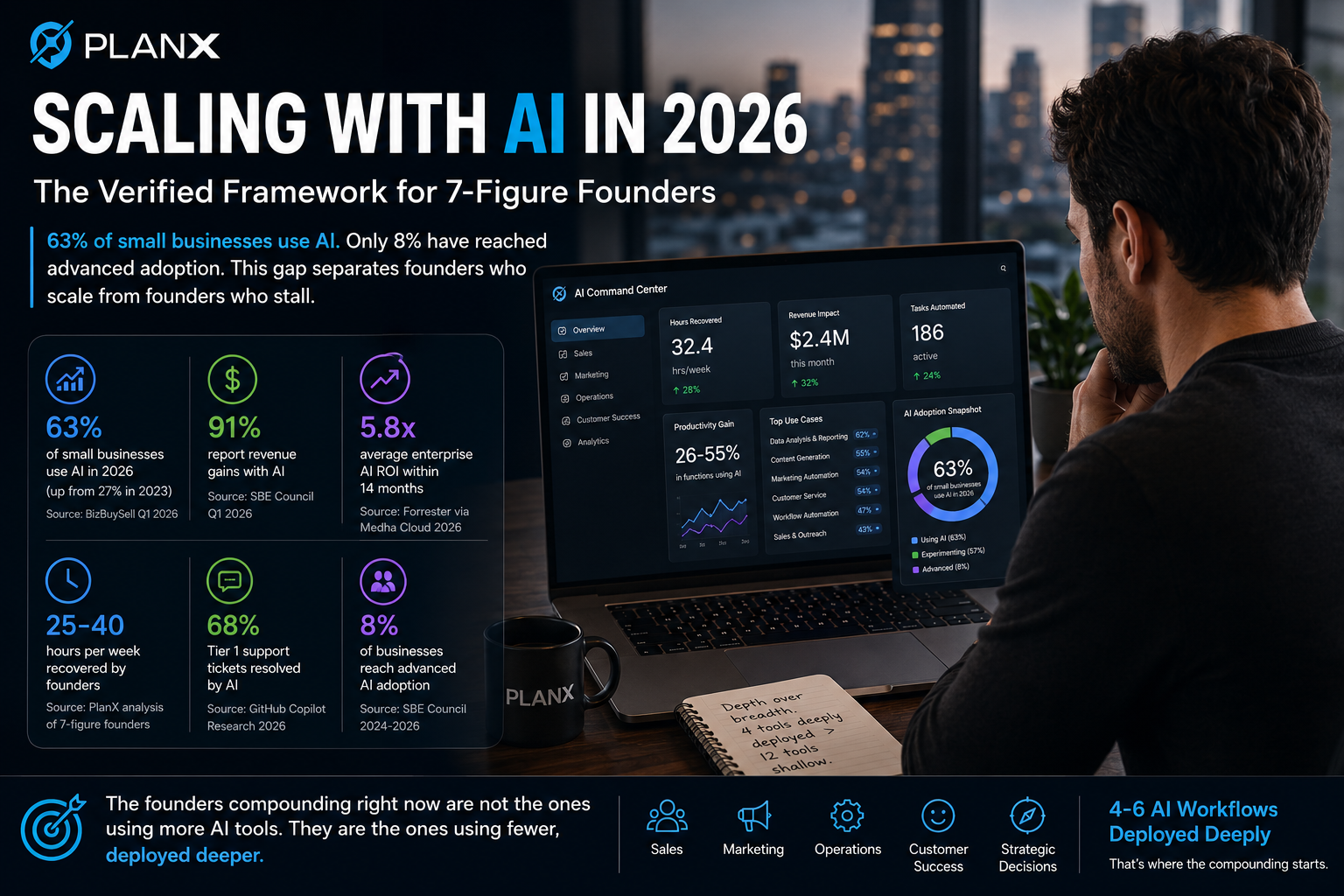
• Small business AI adoption: 63% in 2026, up from 27% in 2023 (BizBuySell) • AI users reporting revenue gains: 91% (Salesforce SMB Trends) • Small businesses planning to keep investing in AI: 93%; only 8% reach advanced adoption (SBE Council) • Marketing automation adoption: 96% of marketers, 5x average ROI (Thunderbit) • Founder time reclaimed with full marketing automation: ~27 hours/week (Enrich Labs) • Productivity gains where AI is deployed: 26 to 55% (Stealth Agents 2026) • AI chatbots resolving Tier 1 support tickets: 68% (industry data) • Typical winning pattern: 3 to 5 AI workflows deployed deeply, not 12 shallow • Dubai context: UAE captured 66.5% of MENA startup funding in Q1 2026 (Wamda) • By 2030, 60% of organizations differentiating with AI will be led by executives who prioritize human relational skills (Gartner) • Dubai active startups: 3,500+, combined valuation $28B+ (2026) Sources linked above open in a new tab. Figures reflect 2026 benchmark data from the cited organizations. |
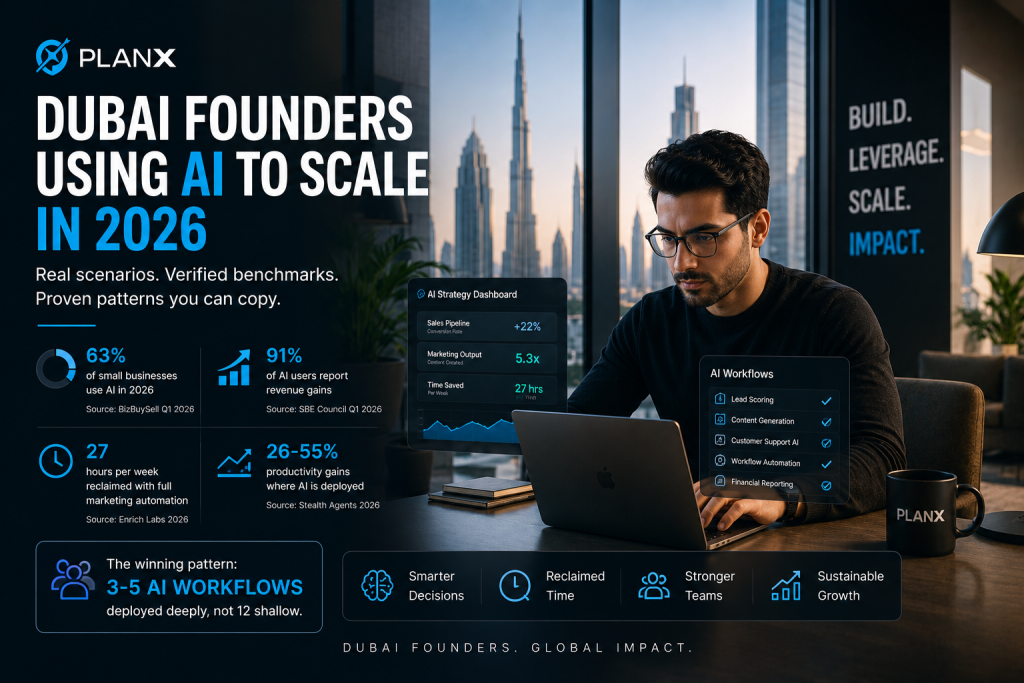 The founders pulling ahead in Dubai’s ecosystem are not using more AI tools. They are deploying a few of them deeply and systematically.
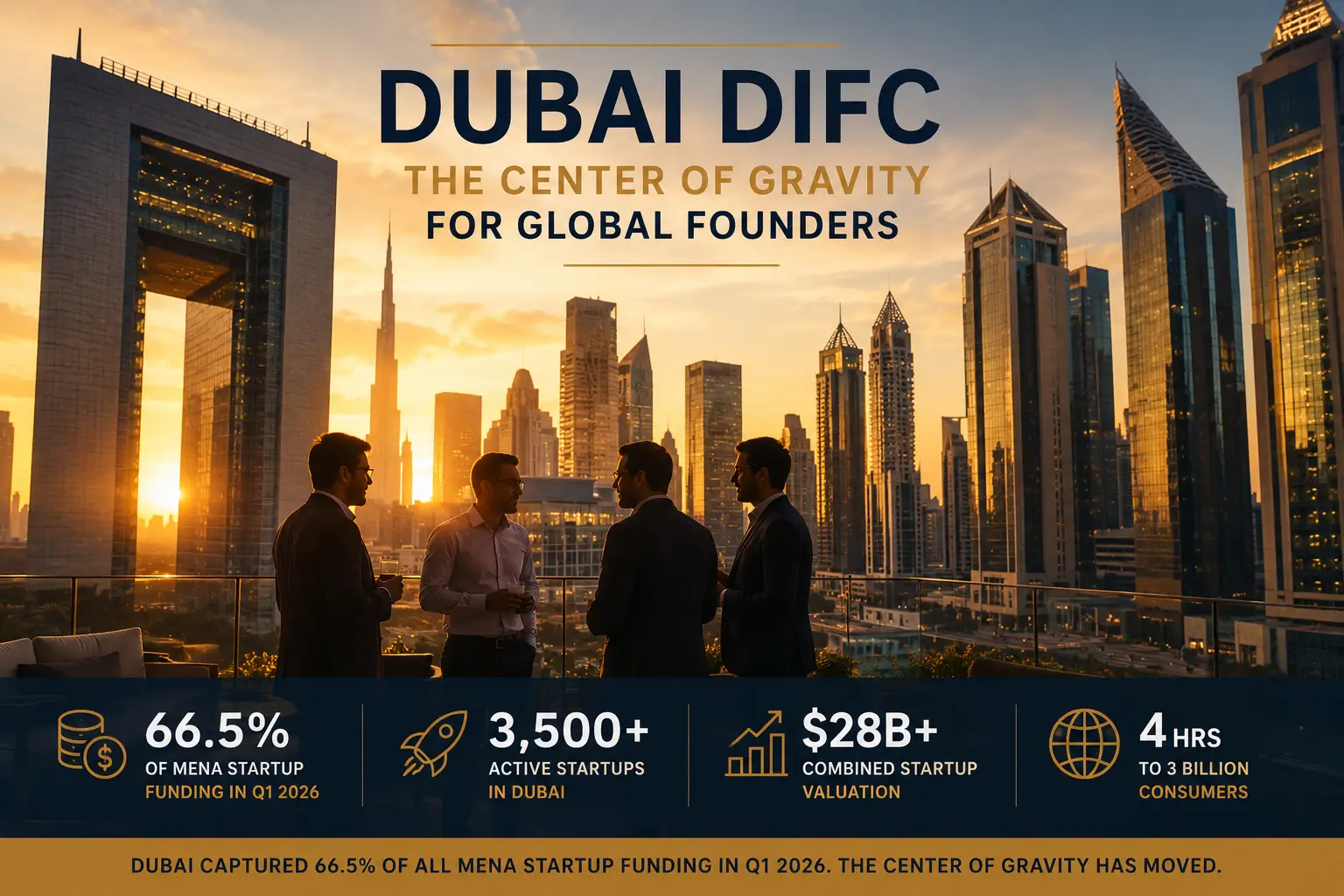
Dubai has become one of the most concentrated founder ecosystems in the world. The UAE captured 66.5% of all MENA startup funding in Q1 2026 (Wamda), and Dubai alone now hosts more than 3,500 active startups. Inside that ecosystem, a clear divide is opening up between founders who use AI as a novelty and founders who use it as an operating system.
This post shows the second group. Seven illustrative scenarios of how 7-figure founders in the Dubai community deploy AI to actually scale, not to play with. Each one is a composite built from patterns we see repeatedly, with results grounded in the verified 2026 benchmarks above. The point isn’t to show you impressive numbers. It’s to show you patterns you can copy.
Across all seven, one theme repeats: the founders winning with AI deploy a few workflows deeply rather than chasing every tool. If you want the strategic framework behind this, start with our AI scaling pillar for 7-figure founders. This post is the applied version: what it actually looks like in practice.
| Which of these patterns fits your business?
After reading these, you’ll likely recognize one or two that match your situation. The 2-minute Founder Bottleneck Quiz tells you which AI deployment would move the needle fastest for you specifically. Built for founders past their first $1M. |
How are Dubai founders using AI to scale in 2026?
Dubai founders are deploying AI across seven main areas in 2026: sales, marketing, customer support, operations, strategy, hiring, and finance. The seven composite scenarios below show each pattern in detail, the situation, what the founder deployed, and the realistic results grounded in 2026 benchmarks. Each is a representative pattern you can adapt to your own business.
Case 1: The B2B services founder who fixed a leaky sales pipeline
Illustrative composite. Profile: a founder running a roughly $2M ARR B2B services business from a Dubai free zone, serving regional and international clients.
The situation: inbound leads were coming in, but the small sales team was responding slowly and spending time on leads that never converted. The founder was personally reviewing deals that weren’t worth the time.
What they deployed: AI lead scoring and qualification (enriching each inbound lead, scoring it against historical conversion patterns, and routing high-fit leads to the team within minutes). Low-fit leads went to an automated nurture sequence.
| AI deployed | Lead scoring + routing + automated nurture |
| Time saved | 4 to 8 hours/week of founder and sales-team time |
| Conversion impact | 15 to 30% improvement in sales focus on high-probability deals (2026 benchmark range) |
| Why it worked | Faster response to high-fit leads captures the conversion advantage of responding in minutes vs hours |
Case 2: The solo founder running marketing like a full team
Illustrative composite. Profile: a solo founder with a roughly $1.2M ARR digital business, no marketing hire, doing everything personally.
The situation: marketing was the thing that always slipped. The founder knew content and distribution mattered but couldn’t sustain the output alone.
What they deployed: an AI marketing stack. One core content piece per week, repurposed by AI into 8 to 12 derivatives across formats, plus AI email nurture and automated reporting.
| AI deployed | Content repurposing + email automation + reporting |
| Time saved | Substantial; marketing automation reclaims up to ~27 hours/week at full deployment (Enrich Labs 2026) |
| Output impact | 8 to 12x content reach from the same source material |
| Why it worked | Distribution, not creation, was the bottleneck; AI multiplied reach without a hire |
Case 3: The SaaS founder who cut support load without cutting quality
Illustrative composite. Profile: a founder running a roughly $3M ARR SaaS product with a growing support burden.
The situation: support tickets were scaling with the customer base, and the founder was facing pressure to keep hiring support staff to keep up.
What they deployed: an AI support agent trained on help docs and past tickets, resolving routine Tier 1 issues directly and escalating only what it couldn’t confidently handle.
| AI deployed | AI customer support + ticket triage |
| Resolution impact | Roughly 68% of Tier 1 tickets resolved without human escalation (2026 industry benchmark) |
| Team impact | Support scaled with the customer base without proportional new hires |
| Why it worked | AI handled volume; humans handled the complex and high-stakes tickets |
Case 4: The founder who reclaimed a full day a week from operations
Illustrative composite. Profile: a founder running a roughly $4M ARR business who had become the operational bottleneck.
The situation: too much of the founder’s week went to operational glue: approvals, status updates, meeting admin, internal questions, reporting.
What they deployed: a stack of operational AI workflows, AI meeting intelligence, inbox triage, internal knowledge base, and reporting automation, layered in over a few months.
| AI deployed | Meeting intelligence + inbox triage + knowledge base + reporting |
| Time saved | 15 to 25 hours/week of founder time at full deployment (2026 benchmark range) |
| Team impact | Internal questions dropped sharply once the AI knowledge base was live |
| Why it worked | Stacked workflows that compounded, deployed in order rather than all at once |
Case 5: The founder who used AI to make a hard pricing call
Illustrative composite. Profile: a founder running a roughly $2.5M ARR business who suspected they were underpricing but feared churn if they raised prices.
The situation: a high-stakes pricing decision the founder kept avoiding because the downside of getting it wrong felt large.
What they deployed: AI for strategic decision support. They fed a frontier model their real pricing, costs, churn, and competitor data, modeled several pricing structures, and stress-tested the analysis by having the AI argue against raising prices.
| AI deployed | AI strategic analysis (pricing) with frontier models |
| Analysis impact | Compressed weeks of analysis into days; surfaced considerations the founder had missed |
| Decision impact | A more confident, better-informed pricing decision (founder retained the final call) |
| Why it worked | AI informed the decision; the founder stayed accountable for it |
Case 6: The founder who stopped making expensive hiring mistakes
Illustrative composite. Profile: a founder running a roughly $3.5M ARR business scaling the team, where a single mis-hire could cost six figures.
The situation: hiring was rushed and inconsistent. The founder interviewed without preparation and had made costly mis-hires before.
What they deployed: an AI-assisted hiring pipeline, parsing and scoring applications, drafting role-specific interview questions, summarizing candidates, and structuring the decision process.
| AI deployed | AI hiring pipeline + interview prep + decision structuring |
| Time saved | 5 to 10 hours per role for the founder and hiring team |
| Quality impact | Higher interview quality and a more structured, lower-risk hiring decision |
| Why it worked | AI prep raised the quality of every interview without adding founder time |
Case 7: The founder who finally had real-time numbers
Illustrative composite. Profile: a founder running a roughly $5M ARR business making decisions on month-old financial data.
The situation: pulling current numbers took so long that the founder often made spend, hiring, and runway decisions on stale data.
What they deployed: automated financial reporting, connecting accounting, banking, and CRM data into AI-generated dashboards with plain-language summaries of what changed and why.
| AI deployed | Automated financial reporting + dashboards + anomaly detection |
| Time saved | 4 to 8 hours/week of founder and finance time |
| Decision impact | Continuously available data improved the quality of spend, hiring, and runway decisions |
| Why it worked | The value was not just time saved; it was better decisions from current data |
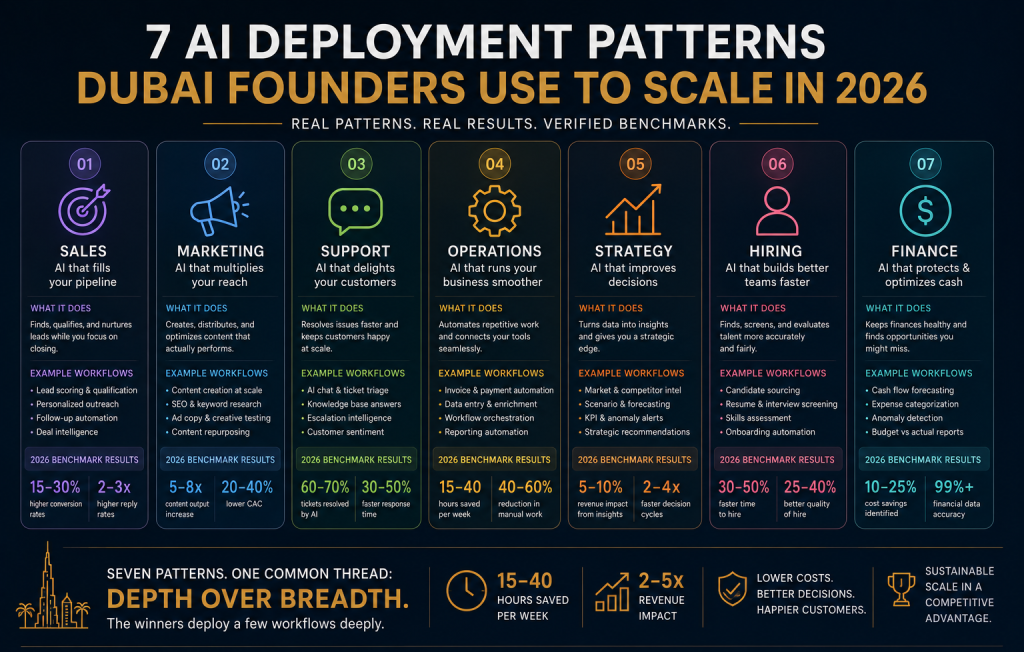 Seven patterns, one common thread: depth over breadth. The winners deploy a few workflows deeply.
What do these founders have in common?
Across all seven patterns, the founders seeing real results share four habits: they deploy a few AI workflows deeply rather than chasing every tool, they start from a specific bottleneck rather than from a tool, they keep humans accountable for high-stakes decisions, and they measure the results. These habits matter more than which specific tools they choose.
1. Depth over breadth
None of these composites involve a founder running 15 AI tools. Each one involves 1 to 5 workflows deployed properly. This matches the 2026 data: only 8% of businesses reach advanced AI adoption (SBE Council), and the differentiator is depth of deployment, not number of tools.
2. Bottleneck first, tool second
Every pattern starts with a specific business constraint (slow sales response, unsustainable marketing, support load, operational drag, a hard decision) and then applies AI to it. None start with “we should use this tool.” This is the single biggest predictor of whether AI deployment produces ROI.
3. Humans accountable for big calls
In the strategic and hiring cases especially, AI informs the decision but the founder makes it. This is the responsible and effective pattern, consistent with Gartner’s finding that the leaders differentiating with AI prioritize judgment over pure automation.
4. They measure
Each pattern has a measurable outcome: hours saved, conversion improvement, tickets resolved, decision quality. The founders who treat AI as something to measure are the ones who know what’s working and double down on it.
| Find your pattern
You probably recognized one or two of these scenarios. The 2-minute Founder Bottleneck Quiz tells you which AI deployment would move the needle fastest in your specific business. Built for founders past their first $1M. Free. |
Frequently Asked Questions
How are Dubai founders actually using AI in 2026?
Across seven main areas: sales pipeline acceleration, marketing content production, customer support automation, operational workflows, strategic decision-making, hiring, and financial reporting. The common pattern is depth over breadth, deploying 3 to 5 AI workflows well rather than chasing every tool. Grounded in 2026 benchmarks, founders doing this typically reclaim 15 to 40 hours per week and improve sales conversion 15 to 30%.
Are these case studies real?
They are illustrative composites, not profiles of specific individuals. Each is built from common patterns across the founder community and grounded in verified 2026 AI adoption benchmarks (BizBuySell, SBE Council, Thunderbit, Enrich Labs). Results are presented as realistic ranges from those benchmarks, not guaranteed outcomes. We use composites to show the full pattern clearly without exposing any individual founder’s private business data.
What results can a founder realistically expect from AI in 2026?
Based on 2026 benchmarks: founders deploying AI across a few workflows typically reclaim 15 to 40 hours per week, improve sales pipeline conversion 15 to 30%, resolve roughly 68% of Tier 1 support tickets without human escalation, and multiply content reach 5 to 8x. Marketing automation specifically shows an average 5x ROI. Actual results vary based on the business, implementation quality, and market.
What’s the most common AI use case for founders in Dubai?
Sales and marketing are the most common entry points because they have the clearest, fastest ROI. Marketing automation has 96% adoption among marketers with an average 5x return, and sales AI (lead scoring, outreach) typically improves sales team focus 15 to 30%. Operations and strategic decision-making are higher-leverage but less commonly deployed, which is where the bigger 2026 edge sits.
How many AI tools should a founder use?
Fewer than most think. The founders seeing the biggest gains deploy 3 to 5 AI workflows deeply rather than running a dozen shallow ones. Only 8% of businesses reach advanced AI adoption in 2026, and the differentiator is depth of deployment, not number of tools. Start with the one or two workflows that match your biggest bottleneck.
What makes Dubai a strong ecosystem for AI-driven founders?
Dubai concentrates capital, talent, and ambition. The UAE captured 66.5% of MENA startup funding in Q1 2026, Dubai hosts 3,500+ active startups, and the government actively backs AI through initiatives and regulation. For a founder using AI to scale, being in a dense ecosystem of other AI-forward founders accelerates learning and partnerships.
Do I need technical skills to deploy AI like these founders?
Mostly no. The majority of these patterns (lead scoring, content repurposing, support automation, reporting, strategic analysis) can be deployed with no-code tools and frontier AI models in 2026. The complex exceptions (custom multi-agent systems, deep proprietary integrations) need technical help. Most founders start with the no-code workflows and only bring in technical help for advanced builds.
How do I start deploying AI in my own business?
Start with diagnosis, not tools. Identify your single biggest bottleneck (sales, marketing, support, operations, or a specific decision), then deploy the one AI workflow that addresses it. Measure the result over 30 days. Then add the next. This matches the pattern across all seven scenarios: bottleneck first, one workflow at a time, measure as you go. The Bottleneck Quiz is a fast way to find your starting point.
Where can I meet other founders using AI to scale?
PlanX 2026 in Dubai (November 25 to 26) is built for exactly this, with a dedicated Leverage track on AI workflows, automation, and operational systems, and a community of 7-figure founders deploying AI. Meeting founders who’ve run the exact playbook you need compresses months of solo experimentation into a few conversations.
Meet founders running these playbooks at PlanX 2026
These composites show the patterns. Meeting the actual founders running them, and hearing the real numbers behind closed doors, is what compresses your own implementation.
PlanX 2026 is the 2-day founder conference in Dubai built for operators scaling past 7 figures, with a dedicated Leverage track on AI workflows, automation, and operational systems. November 25 to 26 at Grand Hyatt Dubai. 2,500 founders. 40+ speakers. Three tracks: Growth, Leverage, Network.
It’s where the founders behind patterns like these share what actually worked, what they’d skip, and the specific stacks they built. Tactical and current, from operators who’ve done it.
| Lock in PlanX 2026 tickets
Super Early Bird Global Access at $299 (50% off, available May to June). Limited Offer with 2 nights at Grand Hyatt at $698 (only 150 units total). Sovereign VIP with private yacht after-party at $599 Super Early Bird. |
Going deeper: the complete AI scaling library
This post shows the patterns in action. The rest of the library shows you how to deploy them:
- The strategic framework: Scaling with AI: The 2026 Playbook for 7-Figure Founders (the pillar guide).
- The operational tactics: AI Workflows for Founders, 12 automation patterns that return 15+ hours a week.
- The marketing layer: AI Marketing Automation Guide.
- The strategic decision layer: AI for Business Strategy.
- Meet the operators in person: AI Conference Dubai, PlanX 2026.
The bottom line
Across every one of these seven patterns, the lesson is the same. The founders scaling with AI in Dubai’s ecosystem are not the ones with the most tools or the biggest budgets. They’re the ones who picked a specific bottleneck, deployed one AI workflow against it properly, measured the result, and then added the next.
That’s the whole playbook. Depth over breadth. Bottleneck before tool. Humans accountable for the big calls. Measure everything. It’s unglamorous and it works, which is exactly why only 8% of businesses have reached advanced adoption while everyone else experiments.
If you recognized your business in one of these scenarios, that recognition is the starting point. Find your bottleneck, deploy the matching workflow, and measure what happens. Then do it again.
| Find your starting point
The 2-minute Founder Bottleneck Quiz tells you which AI deployment matches your biggest constraint right now. Built for founders past their first $1M. Free. |