Most founders use AI to execute tasks faster. The real leverage is using AI to make better decisions before you execute. Here’s the 2026 playbook for AI-assisted strategic decision-making, built for founders, not enterprises.
| Written by the PlanX team • Last updated: June 2026 • Reviewed for accuracy: June 2026
Sources cited: MIT Sloan 2026, PwC 2026 AI Business Predictions, Deloitte 2026 leadership survey, Gartner 2026 research |
| QUICK ANSWER
AI for business strategy means using artificial intelligence to improve the quality and speed of strategic decisions: pricing, market sizing, competitive positioning, hiring, partnerships, and capital allocation. Unlike AI for execution (which does tasks faster), AI for strategy compresses analysis that used to take weeks into days and reduces the cost of being wrong about big decisions. For 7-figure founders in 2026, the practical approach is lean: use frontier AI models (Claude, ChatGPT, Gemini) with your real business data and clear decision criteria, keep humans accountable for high-stakes calls, and treat AI as an analytical input rather than a decision-maker. The founders gaining the most edge are using AI to think better, not just work faster. |
| AI for Business Strategy 2026: Key Facts
• AI moved from boardroom topic to execution priority in 2026 (MIT Sloan, PwC) • The 2026 shift: from individual productivity to enterprise decision-making (MIT Sloan) • Worker access to AI tools rose 50% in 2025 (Deloitte survey of 3,000+ leaders) • By 2030, 60% of orgs differentiating with AI will be led by executives prioritizing relational skills over technical (Gartner) • 38% of AI adoption challenges stem from insufficient training (2026 research) • Enterprise AI strategy timeline: 8-12 weeks to build, 12-18 months to execute • The core 2026 tension: use AI to inform decisions faster while keeping humans accountable for high-stakes calls • Best practice: define outcomes in business language, not tool language • Use-case scoring: impact, feasibility, risk, data readiness, time to value • Frontier models for strategy work: Claude, ChatGPT, Gemini Deep Research |
 The founders pulling ahead in 2026 use AI to make better decisions, not just to execute faster. Different category entirely.
Ask most founders how they use AI and you’ll hear the same list: writing content, drafting emails, summarizing meetings, generating social posts. All execution. All useful. All table stakes in 2026.
Here’s what almost no one is doing: using AI to make better strategic decisions. Pricing. Market sizing. Whether to hire that role. Whether to take that partnership. How to allocate the next $200K. These are the decisions that actually determine whether a 7-figure business becomes an 8-figure business, and most founders make them the same way they did in 2019: gut feel, a spreadsheet, and a few conversations.
This is the biggest untapped edge in 2026. AI is now good enough to compress strategic analysis that used to take weeks into a few days, to stress-test your assumptions, to surface considerations you’d have missed, and to reduce the cost of being wrong about decisions that matter. Not by replacing your judgment. By making your judgment better-informed and faster.
This guide covers AI for business strategy specifically for founders, not the enterprise version with AI factories and governance committees. It’s part of our AI scaling pillar for 7-figure founders, and it goes deep on the highest-leverage and least-used AI application: strategic decision-making.
| What decision is your business actually stuck on?
Most founders have one or two strategic decisions quietly capping their growth right now. The 2-minute Founder Bottleneck Quiz helps you find yours, and whether AI-assisted analysis is the unlock. Built for founders past their first $1M. |
What is AI for business strategy?
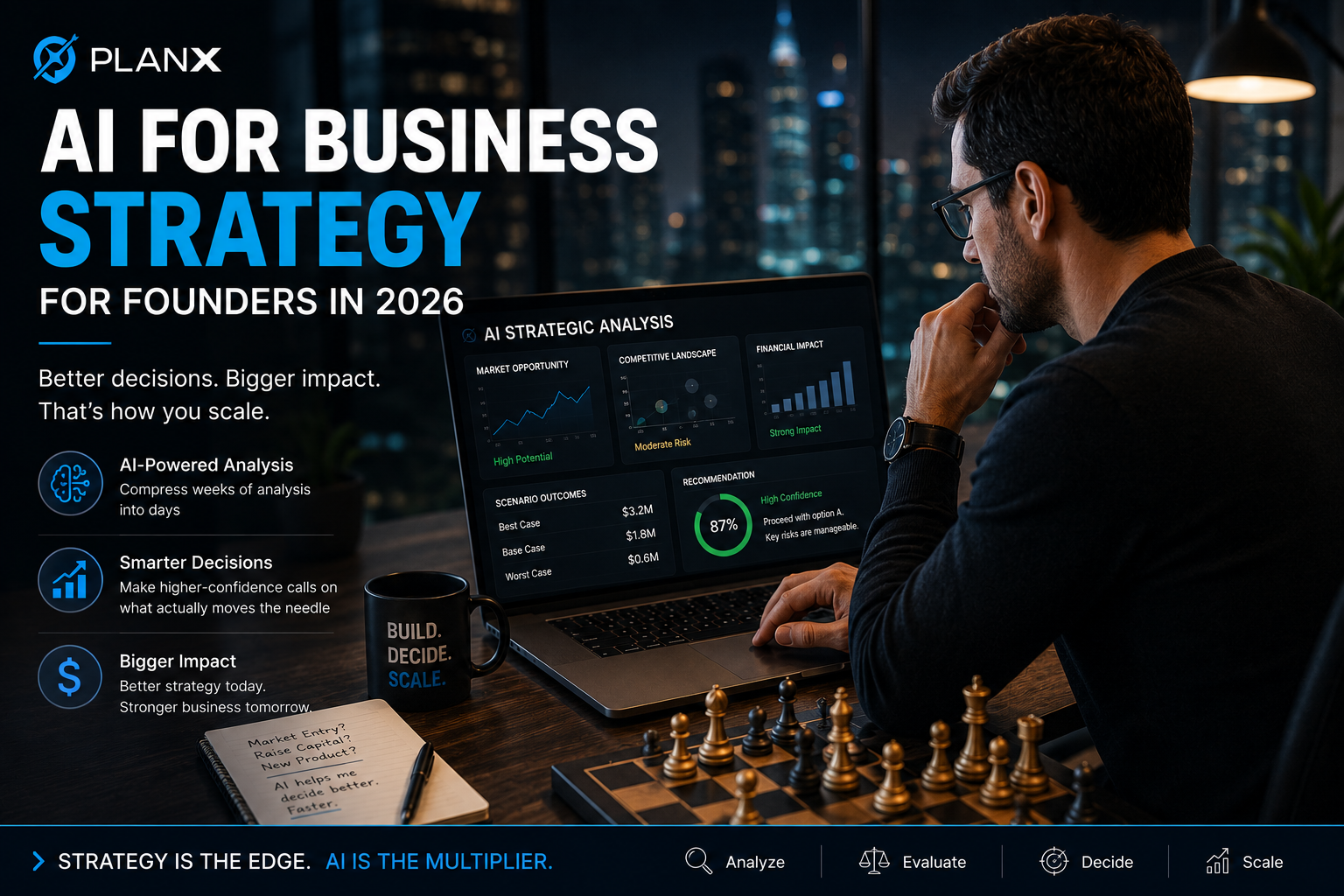
AI for business strategy is the use of artificial intelligence to improve strategic decision-making: analyzing markets, evaluating options, stress-testing assumptions, and modeling outcomes before a founder commits resources. It differs from AI for execution (content, automation, operations) in that the goal is decision quality, not task speed. In practice, founders use frontier AI models to compress weeks of analysis into days, surface blind spots, and make higher-confidence calls on pricing, hiring, partnerships, market entry, and capital allocation.
Strategy vs execution: the distinction that matters
AI for execution answers “how do I do this task faster?” AI for strategy answers “is this the right thing to do, and how do I know?” The first saves time. The second changes outcomes. A founder who saves 10 hours a week with AI execution but makes the same quality of strategic decisions is more efficient. A founder who uses AI to make materially better pricing, hiring, and capital decisions is building a different company.
Why 2026 is the inflection point
Per MIT Sloan’s 2026 analysis, AI has mostly been used at the individual productivity level, with employees using it to boost their own output. The shift now underway is toward applying AI to enterprise decisions and processes. For founders, this means the tooling and the models are finally good enough to trust as a strategic analysis input, not just a writing assistant.
Which strategic decisions can AI actually help founders make?
AI helps founders most with seven categories of strategic decision: pricing and packaging, market sizing and opportunity, competitive positioning, hiring and team design, partnership evaluation, capital allocation, and product roadmap prioritization. In each, AI compresses the analysis, surfaces considerations the founder might miss, and models outcomes, while the founder retains accountability for the final call. These are the decisions where better analysis produces the largest financial difference.
1. Pricing and packaging
The highest-leverage decision most founders under-analyze. Feed AI your current pricing, your costs, competitor pricing, customer segments, and willingness-to-pay signals. AI models the revenue impact of different pricing structures, identifies where you’re leaving money on the table, and stress-tests your assumptions. A 10% pricing improvement often flows straight to profit. Few decisions have higher ROI on the analysis time.
2. Market sizing and opportunity
Before entering a new market, launching a product, or doubling down on a segment, founders need to size the opportunity honestly. AI compresses what used to be weeks of research into a structured analysis: market size, growth rate, competitive density, customer acquisition economics, and the realistic capturable share. It won’t be perfect, but it’s far better than the back-of-napkin estimate most founders run on.
3. Competitive positioning
AI analyzes your competitors’ positioning, messaging, pricing, and customer sentiment, then helps you find the gap you can own. Where are competitors weak? What are customers complaining about? What positioning is uncontested? This analysis used to require a consultant or weeks of manual research. AI does the first 80% in an afternoon.
4. Hiring and team design
Should you hire a senior person or two junior people? A generalist or a specialist? In-house or fractional? AI helps you model the cost, the ramp time, the risk, and the expected output of different hiring decisions against your specific situation. It also drafts scorecards, structures interview processes, and reduces the chance of an expensive mis-hire, which for a 7-figure founder can cost six figures in salary plus opportunity cost.
5. Partnership evaluation
Partnerships look attractive on the surface and often destroy time and focus. AI helps you evaluate a potential partnership against your strategic priorities: what’s the realistic upside, what are the risks, what’s the opportunity cost, what does the downside look like. A structured AI analysis surfaces the questions founders skip when they’re excited about a deal.
6. Capital allocation
Where should the next $100K to $500K go? Marketing, hiring, product, acquisition, reserves? AI models the expected return and risk of different allocation choices against your actual numbers and goals. This is the decision that most directly compounds (or erodes) over time, and the one founders most often make on instinct alone.
7. Product roadmap prioritization
Which features, which order, which to cut. AI helps you weigh customer demand signals, revenue impact, development cost, and strategic fit to prioritize the roadmap objectively, rather than building whatever the loudest customer asked for last.
 Seven decisions where better analysis produces the biggest financial difference. Most founders use AI for none of them.
How do founders use AI for strategic decisions in practice?
The practical method has four steps: frame the decision clearly, give AI your real data and context, ask it to analyze rather than to decide, and stress-test the output before you act. Use frontier models (Claude, ChatGPT Pro, Gemini Deep Research) for the reasoning. The quality of the output depends almost entirely on the quality of the input: vague questions produce vague analysis, while specific questions with real numbers produce genuinely useful strategic input.
Step 1: Frame the decision in business language
Don’t ask “what should my pricing be?” Ask “I sell a $2,000/month B2B service to 40 clients, my main competitor charges $3,500, my churn is 4% monthly, and I want to model whether raising to $2,800 would increase or decrease total revenue accounting for likely churn.” The specific framing is what produces specific analysis.
Step 2: Give AI your real data and context
AI analysis is only as good as the inputs. Provide actual numbers: revenue, costs, conversion rates, customer segments, competitor data. The more real context you give, the more useful the output. This is also why data readiness matters. If your numbers are scattered and unreliable, fix that first.
Step 3: Ask AI to analyze, not to decide
Frame the request as analysis: “walk me through the considerations,” “model the outcomes of these three options,” “what am I missing,” “argue the case against this decision.” AI is excellent at structured analysis and stress-testing. It should inform your decision, not make it. You stay accountable for the call.
Step 4: Stress-test before you act
Use AI to argue against its own analysis. Ask it to make the strongest case for the opposite decision. Ask what would have to be true for this to be a mistake. This adversarial step catches the overconfident analysis and surfaces the risks you’d otherwise discover the hard way.
| The accountability principle (do not skip this)
Per Deloitte’s 2026 survey of over 3,000 senior leaders and Gartner’s research, the winning approach balances using AI to inform decisions faster while keeping humans accountable for anything with serious consequences. By 2030, Gartner projects that 60% of organizations achieving real differentiation with AI will be led by executives who prioritize human judgment and relational skills over technical ones. AI is the analyst. You are the decision-maker. Never invert that on high-stakes calls. |
What AI tools are best for business strategy in 2026?
For strategic analysis, the best 2026 tools are frontier reasoning models: Claude (strongest for long-context analysis and structured reasoning), ChatGPT Pro (broad capability and ecosystem), and Gemini Deep Research (strong for research-heavy strategic questions). Unlike marketing or workflow tools, strategy work doesn’t need specialized software. It needs a capable reasoning model, your real business data, and good framing. Most founders doing this well use 2 or 3 of these models and compare their analysis.
- Claude: Strongest for long-context strategic analysis, working through complex multi-variable decisions, and structured reasoning. Good default for deep strategy work.
- ChatGPT Pro: Broad capability, strong ecosystem, good for iterative strategic conversations and connecting to other tools.
- Gemini Deep Research: Strong for research-heavy strategic questions that require pulling and synthesizing external information (market sizing, competitive landscape).
- Perplexity Pro: Useful for the research layer, surfacing current data and sources to feed into your strategic analysis.
A practical pattern: use Perplexity or Gemini Deep Research to gather the external data, then use Claude to run the structured strategic analysis on it. Compare against ChatGPT to catch anything one model missed. Three perspectives on a major decision, in an afternoon, for the cost of a few subscriptions.
| Which strategic decision should you tackle first?
The 2-minute Founder Bottleneck Quiz helps you identify the decision most likely to unlock your next stage of growth, and whether AI-assisted analysis is the move. Built for founders past their first $1M. Free. |
What are the biggest mistakes founders make with AI strategy?
The biggest mistakes are: letting AI make the decision instead of informing it, feeding AI vague questions or bad data, trusting the first answer without stress-testing, using AI only for execution and never for strategy, and treating AI output as fact rather than analysis. Each undermines the quality of the decision and the value of the tool.
1. Letting AI decide instead of informing
The most dangerous mistake. AI is a brilliant analyst and a poor decision-maker for anything with real consequences. It lacks your full context, your risk tolerance, and accountability for the outcome. Use it to inform. Keep the decision yours.
2. Vague questions, bad data
“What should my strategy be?” produces generic platitudes. AI strategy work requires specific questions and real numbers. Garbage in, garbage out applies more sharply to strategy than to almost any other AI use.
3. Trusting the first answer
AI sounds confident even when it’s wrong. The founders who get value stress-test every significant analysis: argue the opposite, check the assumptions, verify the data. The ones who get burned take the first plausible-sounding answer and act on it.
4. Execution only, never strategy
Most founders cap their AI use at content and admin. They never point it at the decisions that actually matter. This is leaving the highest-leverage application on the table. The strategic layer is where the real edge is in 2026.
5. Treating output as fact
AI analysis is analysis, not truth. It can be confidently wrong, miss context, or hallucinate specifics. Treat it as a sharp, fast, tireless analyst whose work you always review, never as an oracle.
Frequently Asked Questions
What is AI for business strategy?
AI for business strategy is using artificial intelligence to improve the quality and speed of strategic decisions: pricing, market sizing, competitive positioning, hiring, partnerships, capital allocation, and roadmap prioritization. It differs from AI for execution (content, automation) in that the goal is better decisions, not faster tasks. Founders use frontier AI models with their real business data to compress weeks of analysis into days and stress-test assumptions before committing resources.
How is AI for strategy different from AI for execution?
AI for execution answers “how do I do this task faster?” (writing, automation, reporting). AI for strategy answers “is this the right decision, and how do I know?” (pricing, hiring, market entry). Execution AI saves time. Strategy AI changes outcomes. Most founders use AI heavily for execution and almost never for strategy, which is why strategy is the bigger untapped edge in 2026.
Can AI actually make good strategic decisions?
AI should inform strategic decisions, not make them. It is excellent at structured analysis, modeling options, and stress-testing assumptions. It is poor at decisions requiring full business context, risk judgment, and accountability. The winning 2026 approach, per Deloitte and Gartner research, is to use AI to inform decisions faster while keeping humans accountable for anything with serious consequences. AI is the analyst; the founder is the decision-maker.
What AI tools are best for business strategy in 2026?
Frontier reasoning models: Claude (strongest for long-context analysis and structured reasoning), ChatGPT Pro (broad capability), and Gemini Deep Research (research-heavy strategic questions). Perplexity Pro is useful for the research layer. Strategy work does not need specialized software, it needs a capable model, your real data, and good framing. Many founders use 2 or 3 models and compare the analysis on major decisions.
Which business decisions can AI help me make?
Seven categories where AI helps founders most: pricing and packaging, market sizing and opportunity, competitive positioning, hiring and team design, partnership evaluation, capital allocation, and product roadmap prioritization. These are the decisions where better analysis produces the largest financial difference, and where AI can compress weeks of work into days while surfacing considerations you might miss.
How do I use AI to make a pricing decision?
Frame it specifically with real numbers: your current price, costs, competitor pricing, customer segments, churn rate, and the change you’re considering. Ask AI to model the revenue impact of different pricing structures accounting for likely churn, identify where you’re underpricing, and stress-test the assumptions. Then ask it to argue against raising prices. Pricing is often the highest-ROI strategic decision because improvements flow straight to profit.
Do I need clean data to use AI for strategy?
Yes. AI strategic analysis is only as good as the inputs. If your revenue, costs, conversion rates, and customer data are scattered and unreliable, the analysis will be too. Before using AI for major strategic decisions, get your core numbers into a state you can trust and easily pull. This is the same data-readiness principle that applies across all serious AI use in 2026.
Will AI replace founders and executives in decision-making?
No. Per Gartner, by 2030, 60% of organizations achieving real differentiation with AI will be led by executives who prioritize human judgment and relational skills over technical ones. AI changes what leaders spend time on (less manual analysis, more judgment and relationships) rather than replacing the leader. The skills becoming more valuable in 2026 are leadership, communication, judgment, and change management, not the ability to run the analysis yourself.
How long does AI-assisted strategic analysis take?
For a founder with clean data and a well-framed question, AI can produce a substantive strategic analysis in an afternoon that previously took a consultant or internal team weeks. The time is in the framing and data prep, not the analysis itself. The realistic pattern: a few hours to frame the decision and gather data, then rapid iterative analysis, then a stress-test pass. Days, not weeks.
Is AI for business strategy only for big companies?
No, and arguably founders benefit more. Enterprise AI strategy involves AI factories, governance committees, and 12 to 18 month execution timelines. Founders can use frontier models directly, with their own data, and act on the analysis the same week. The lean version (capable model plus real data plus good framing plus human accountability) is faster and more practical for a 7-figure founder than the enterprise apparatus.
How do I avoid AI giving me confidently wrong strategic advice?
Stress-test everything significant. Ask AI to argue the opposite case. Ask what would have to be true for the analysis to be a mistake. Verify the data and assumptions it used. Compare the analysis across two or three models. Never act on a single confident-sounding answer for a high-stakes decision. AI sounds certain even when wrong, so the adversarial stress-test is what protects you.
When should I attend an AI conference vs just using AI tools myself?
Using AI tools yourself teaches you the mechanics. A conference compresses months of learning from founders who’ve already used AI to make the decisions you’re facing. The math: a 1-hour conversation with a founder who used AI to navigate the exact pricing or expansion decision you’re weighing is worth more than 50 hours of solo experimentation. PlanX 2026 has a dedicated Leverage track covering AI for strategy and decision-making, alongside operators who’ve done it.
Where founders learn AI strategy in person
Reading this teaches you the method. Watching founders who’ve used AI to make the exact decisions you’re facing compresses the learning dramatically.
PlanX 2026 is the 2-day founder conference in Dubai built for operators scaling past 7 figures, with a dedicated Leverage track covering AI for strategy, AI workflows, and operational systems. November 25 to 26 at Grand Hyatt Dubai. 2,500 founders. 40+ speakers. Three tracks: Growth, Leverage, Network.
The Leverage track is where founders share how they actually use AI to make better decisions: the pricing calls, the hiring decisions, the market-entry analysis. Tactical and current, with operators who’ve done it, not theorists describing it.
| Lock in PlanX 2026 tickets
Super Early Bird Global Access at $299 (50% off, available May to June). Limited Offer with 2 nights at Grand Hyatt at $698 (only 150 units total). Sovereign VIP with private yacht after-party at $599 Super Early Bird. |
Going deeper: the complete AI scaling library
This guide is part of the PlanX AI scaling library. Each piece connects to the next:
- The strategic framework: Scaling with AI: The 2026 Playbook for 7-Figure Founders (the pillar guide).
- The operational layer: AI Workflows for Founders, 12 automation patterns that return 15+ hours a week.
- The marketing layer: AI Marketing Automation Guide.
The bottom line on AI for business strategy in 2026
Most founders have AI execution covered and AI strategy completely untouched. That gap is the opportunity. The founders who use AI to make better pricing, hiring, market, partnership, and capital decisions are building materially different companies than the ones using AI only to write faster emails.
The method is straightforward: frame the decision specifically, give AI your real data, ask it to analyze rather than decide, and stress-test before you act. Use frontier models. Keep yourself accountable for high-stakes calls. Treat AI as the sharpest, fastest analyst you’ve ever had, whose work you always review.
If you’re serious about this, start with one decision. Take the Bottleneck Quiz to find the decision most likely to unlock your next stage. Run a proper AI-assisted analysis on it this week. Compare the quality of that decision to how you’d have made it on instinct. Then make it a habit.
The models are good enough now. The data is available. The edge goes to the founders who use AI to think better, not just to work faster.
| Start with your highest-leverage decision
The 2-minute Founder Bottleneck Quiz tells you which strategic decision is most likely capping your growth right now. Built for founders past their first $1M. Free. |